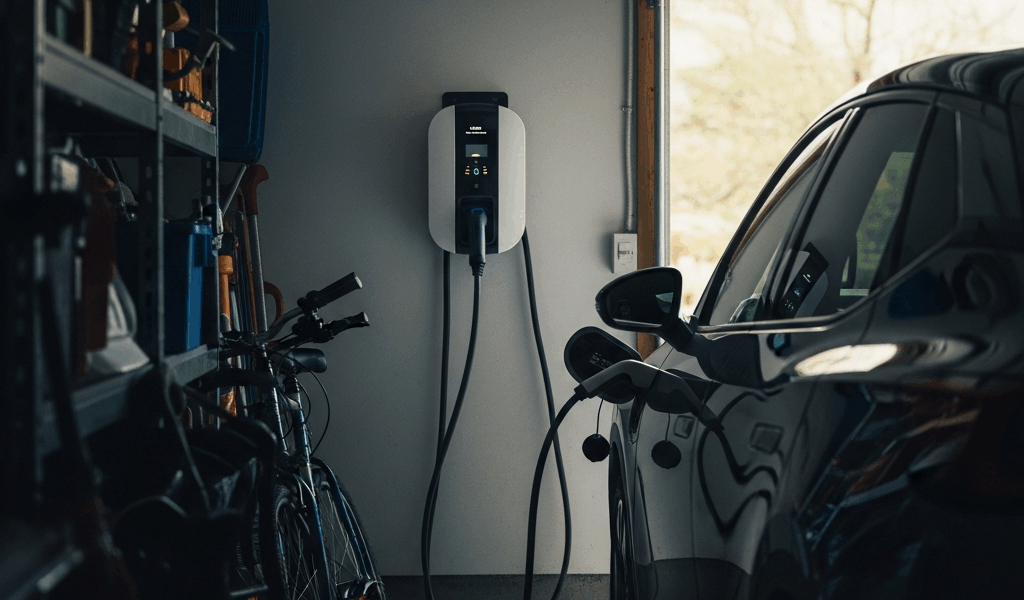
You need a Level 2 home EV charger and the options look identical until you read the fine print. Before comparing brands, answer three questions that determine which charger fits your situation. Get these right and the product choice is obvious.
This article includes affiliate links. We may earn a commission at no extra cost to you.
What to Decide Before Choosing a Charger
Hardwire vs NEMA 14-50 plug. Hardwired installations connect directly to the circuit and require an electrician and a permit in most jurisdictions. Plug-in installations use a NEMA 14-50 outlet — the same outlet your dryer uses — and are typically DIY-eligible once the outlet is installed. Plug-in chargers are portable: if you move, unplug and take it with you.
Amp rating. A 48A charger delivers 11.5 kW and adds 30 to 40 miles of range per hour. A 40A charger delivers 9.6 kW and adds 20 to 25 miles per hour. A 32A charger delivers 7.6 kW and adds 18 to 22 miles per hour. Most homeowners with one EV do fine at 32A to 40A. Multi-EV households benefit from 48A capacity.
Cord length. Measure the distance from your electrical panel location to your parking spot. Most chargers come with 18 or 25-foot cords. An 18-foot cord covers most garage setups where the panel and parking are on the same wall. If your panel is across the garage or in a different room, 25 feet is the safer choice.
Best Level 2 Home EV Chargers for 2026
ChargePoint Home Flex. 32A to 50A adjustable output. Wi-Fi connected with app-based scheduling and energy monitoring. The most popular Level 2 home charger for good reason — it works with every EV, adjusts output to match your circuit capacity, and the scheduling feature saves money on time-of-use utility rates. Around $350 for the charger unit.
Grizzl-E Classic. 40A output. No smart features, no Wi-Fi, no app. Plug it in, it charges. Built like industrial equipment — aluminum housing, NEMA 4 rated for outdoor installation, works in sub-zero temperatures. Best for households that want reliability without connectivity features. Around $250.
JuiceBox 40. 40A output, Wi-Fi connected, Energy Star certified. Load sharing capability for multi-EV households. Around $400. Solid middle ground between the ChargePoint’s flexibility and the Grizzl-E’s simplicity.
Smart Charger vs Dumb Charger
Smart chargers like ChargePoint and JuiceBox offer off-peak charging scheduling, energy monitoring, remote start and stop, and load sharing for multi-EV households.
Worth the premium if your utility has time-of-use rates — scheduling charging to off-peak hours saves $50 to $100 per month on energy bills in some markets. Also worth it for two-EV households where load sharing prevents overloading a shared circuit.
Not worth it if your utility charges a flat rate, you have one EV, and you do not care about monitoring. The Grizzl-E charges your car just as fast without an app. The premium for smart features is $150 to $200.
Installation Cost and Permits
NEMA 14-50 outlet installation: $200 to $400 in most markets. Lower than hardwired, and no permit required in most jurisdictions for a simple outlet installation. Hardwired 240V circuit: $400 to $800, permit required in most areas. Panel upgrade if needed: add $1,500 to $3,500. Washington and Oregon utilities offer EV charger rebates — check Puget Sound Energy, Portland General Electric, and Pacific Power for current programs. The federal tax credit covers up to 30% of charger plus installation cost, capped at $1,000.
The Verdict by Household Type
Single EV, basic charging needs: Grizzl-E Classic 40A with a NEMA 14-50 outlet. Lowest total cost, minimal permit requirements, reliable.
Single EV, want smart scheduling for time-of-use rates: ChargePoint Home Flex. The scheduling feature pays for the premium within 6 months on TOU rate plans.
Multi-EV household: JuiceBox 40 with load sharing capability. Allows two chargers on one circuit without overloading.
Budget install: Any 32A Level 2 charger plus a NEMA 14-50 outlet. Prioritize electrician quality over charger brand — a properly installed circuit matters more than which charger you hang on the wall.

Stay in the loop
Get the latest northwestevcharge.com updates delivered to your inbox.