Tesla Wall Connector vs ChargePoint Home Flex — Which Home Charger Wins
Home EV charging has gotten complicated with all the competing specs, connector standards, and marketing noise flying around. As someone who spent three weeks deep in forum threads, electrician consultations, and one genuinely expensive panel-related mistake, I learned everything there is to know about choosing between these two chargers. If your EV is sitting in the driveway right now and that Level 1 cable is making you feel increasingly ridiculous, this is written for you — not for someone who wants a spec sheet, but for someone who actually needs to pick one and move on.
This article includes affiliate links. We may earn a commission at no extra cost to you.
Both chargers are excellent. That’s the honest answer nobody wants to hear. But they’re excellent for different people — and buying the wrong one is a real possibility.
Compatibility — Tesla Only vs Universal
This is the section that determines everything else. Probably should have opened with this section, honestly, because if you get compatibility wrong, nothing about charging speed or app quality matters even slightly.
The Tesla Wall Connector ships in two versions. The standard version uses Tesla’s proprietary NACS (North American Charging Standard) connector — plug it directly into any Tesla, no adapters, clean and native. Then there’s the Universal Wall Connector, released more recently at around $595, which includes a J1772 connector for non-Tesla vehicles alongside an adapter for Teslas.
The ChargePoint Home Flex uses J1772. Full stop. That’s the industry-standard Level 2 connector that virtually every non-Tesla EV uses natively — Rivian R1T, Ford F-150 Lightning, Hyundai Ioniq 6, Chevy Equinox EV, BMW iX, Volkswagen ID.4, all of them. Tesla owners can still use it with the J1772 adapter that ships with every Tesla, or the official Tesla adapter sold separately for around $35.
But what is NACS adoption, really? In essence, it’s the industry gradually shifting away from J1772 toward Tesla’s connector format as the new standard. But it’s much more than that — it’s a genuine compatibility inflection point that changes how you should think about a charger you’re mounting to your wall for the next decade. Ford, GM, Rivian, Honda, Nissan, Toyota — nearly every major automaker has committed to NACS on new vehicles starting in 2025 and beyond. So the “universal” argument for J1772 is slowly eroding. A Ford F-150 Lightning buyer today uses J1772. A buyer in 2026 might be using NACS natively.
Practically speaking — own a Tesla and plan to keep owning Teslas for the next five to seven years? The native Wall Connector is seamless. Own a Ford, a Chevy, a Hyundai, anything non-Tesla? The ChargePoint Home Flex works without additional hardware. Mixed-EV household? The ChargePoint with a J1772 to Tesla adapter handles both, or you pay more for the Universal Wall Connector.
The Adapter Question
Frustrated by constantly hunting for the J1772 adapter during my first week with the home setup, I learned that leaving adapters dangling from the charger itself is basically asking for them to disappear. A small plastic piece — maybe two inches long — sitting loosely in a garage at 11pm when you just want to plug in and go to bed. Don’t make my mistake. Either designate a permanent spot for it or buy a spare.
That’s what makes the adapter question endearing to us EV owners — we’ll spend thousands on a car and hundreds on a charger, then lose our minds over a $35 piece of plastic. Tesla’s native setup eliminates this entirely for Tesla owners. ChargePoint requires you to manage it. Small thing. But it’s real.
Charging Speed and Power Output
Raw numbers first. The Tesla Wall Connector delivers up to 48 amps — 11.5 kW on a 240-volt circuit. The ChargePoint Home Flex adjusts from 16 amps all the way up to 50 amps, topping out at 12 kW. On paper, ChargePoint is actually slightly faster at maximum output.
What that means in real-world miles per hour of charging:
- Tesla Model Y Long Range on a 48-amp Tesla Wall Connector — approximately 34 miles per hour of charging
- Tesla Model Y Long Range on a 50-amp ChargePoint Home Flex (with J1772 adapter) — approximately 34 to 35 miles per hour
- Ford F-150 Lightning on a 48-amp ChargePoint Home Flex — approximately 30 miles per hour, depending on the onboard charger
- Hyundai Ioniq 6 Long Range on a 48-amp ChargePoint Home Flex — approximately 35 miles per hour
Honestly? For most people these numbers are basically irrelevant. Drive 40 to 60 miles a day and even a 32-amp charger replenishes your battery overnight with hours to spare. The 48-versus-50-amp race only matters if you’re regularly coming home with a nearly dead battery and leaving again the same night — or driving something with a massive pack like the Rivian R1S or Silverado EV.
Installation and Circuit Requirements
While you won’t need to rewire your entire house, you will need a handful of key electrical requirements sorted before buying either charger. Both need a dedicated 240-volt circuit. Full 48 amps on the Tesla Wall Connector means a 60-amp breaker. Full 50 amps on the ChargePoint also means a 60-amp breaker. Older panel without that capacity? Both units run at lower amperages — the ChargePoint’s adjustability is especially useful here. Set it to 32 amps on a 40-amp breaker and you’re still adding 25-plus miles per hour.
First, you should get a licensed electrician to assess your panel — at least if you have a home older than the 1980s. I skipped this step. My 1960s house had a 100-amp main panel, nearly maxed out, and I ended up needing a full panel upgrade alongside the charger installation. That added $1,800 to what I’d mentally budgeted as a $300 job. The charger itself was almost an afterthought by the end of it.
The Tesla Wall Connector retails at $475. The ChargePoint Home Flex lists at $699 but regularly sells in the $549 to $599 range. Electrician installation for either runs $200 to $500 depending on your location, the electrician, and how far the panel sits from your preferred mounting spot.
Smart Features and App Experience
Both chargers connect to WiFi. Both have apps. That’s where the easy comparison ends.
The Tesla Wall Connector lives inside the Tesla app — the same one you’re already using to check battery level, precondition the cabin, set charge limits. The car and charger communicate directly. Schedule charging between midnight and 6am for off-peak rates, set your charge limit to 80%, and the system handles it without you touching anything else. Genuinely seamless — if you’re already a Tesla owner, you’re already in this ecosystem.
The ChargePoint app is its own standalone platform. And in some ways it’s more capable. Detailed energy monitoring — actual kilowatt-hours per session, cost per session once you enter your electricity rate, monthly totals going back as long as you want. Scheduling works from the charger side entirely, no vehicle communication required, which means it works identically regardless of what car you plug in.
The App I Actually Prefer
Having used both — the Tesla app through a family member’s setup and ChargePoint daily on my own installation — the energy monitoring in ChargePoint is something I genuinely open. I know my exact kilowatt-hour consumption from March. I know my cost per mile at my current electricity rate down to the cent. The Tesla app is more elegant and more deeply integrated, but it doesn’t surface raw energy data the same way.
ChargePoint also supports Amazon Alexa and Google Home, which sounds gimmicky. It’s occasionally not. “Hey Google, stop charging” when you realize at 10pm that you set the charge limit wrong is legitimately useful — not world-changing, but useful.
One limitation worth naming directly — the ChargePoint Home Flex doesn’t support vehicle-to-grid or vehicle-to-home bidirectional charging. Neither does the current Tesla Wall Connector. If V2G matters to you, neither of these is your answer. Look at Ford’s Charge Station Pro with a compatible Lightning, or purpose-built V2G equipment from companies like Wallbox.
Build Quality and Physical Design
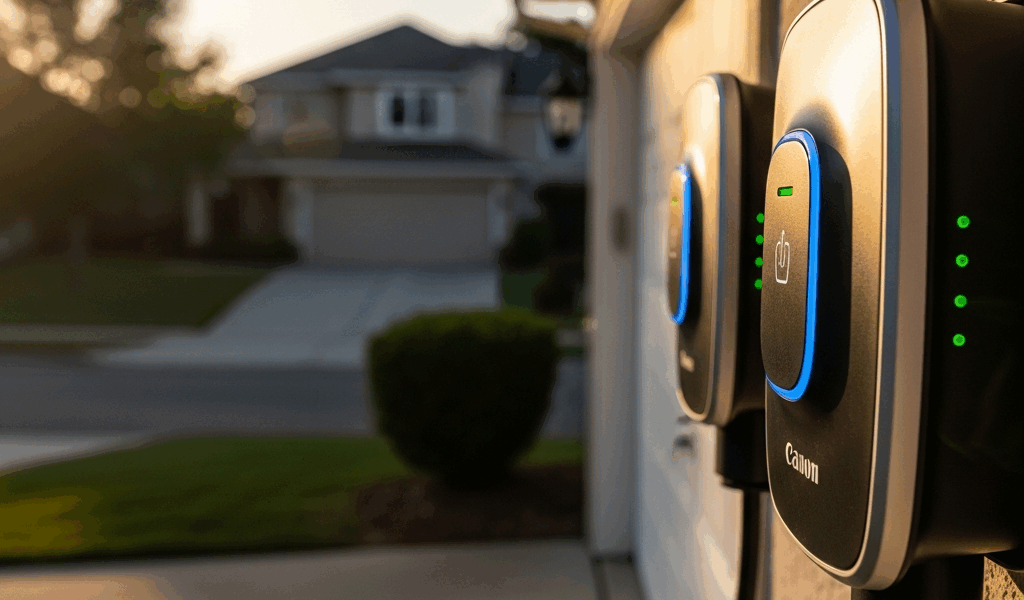
The Tesla Wall Connector might be the best-looking option, as home charging equipment requires something you’ll stare at every time you pull into the garage. That is because Tesla actually designed it to look like a product rather than electrical hardware — white or black brushed aluminum face, 8.5 pounds, a satisfying magnetic cable holster, 24-foot cable with good reach around the car. People actually comment on it. That’s apparently a thing.
The ChargePoint Home Flex is more utilitarian. Plastic construction, available in black or white, visually less premium. Cable comes in 18 or 23 feet depending on configuration. IP55-rated for weather resistance, so outdoor installation in a covered spot is fully supported. The Tesla Wall Connector is technically outdoor-rated too but feels more at home inside aesthetically.
Both carry UL certification. Neither has a reputation for hardware failure in normal residential use. You’re not rolling the dice on reliability with either one.
The Verdict — Which One to Buy
Driven by the assumption that the charger would outlast the car — and probably two cars — I installed the ChargePoint Home Flex. Here’s the honest breakdown by situation.
Buy the Tesla Wall Connector If
- You own a Tesla and plan to own Teslas exclusively for the foreseeable future
- You want native app integration without managing a second account or platform
- Aesthetics matter — the Wall Connector’s design genuinely stands out in a garage
- You’re buying the Universal version and want one charger that handles both Tesla and non-Tesla vehicles without any adapters at all
The Tesla Wall Connector is the right call for Tesla households that aren’t going anywhere. Integration is real, design is excellent, and the $475 price point undercuts the ChargePoint. Tesla also offers multi-charger load-sharing — up to four Wall Connectors sharing a single circuit — which is useful for multi-EV households or small multi-unit buildings.
Buy the ChargePoint Home Flex If
- You own a non-Tesla EV today — a Rivian, Ford, Chevy, Hyundai, BMW, anything with a native J1772 port
- Your household has mixed EVs and you want one charger that handles all of them
- You plan to keep this charger through multiple vehicle changes over the next decade
- Energy monitoring and per-session data actually matter to you
- You need amperage flexibility because your panel can’t support a full 60-amp circuit
The ChargePoint Home Flex is the more flexible long-term investment. Sell your Tesla, buy an Ioniq 5, and the charger still works without touching anything. The $699 retail is higher — the value case is built entirely on longevity and compatibility rather than any single feature being better.
The Honest Middle Ground
Own a Tesla today but genuinely unsure what you’ll drive in five years? The Tesla Universal Wall Connector at $595 is a reasonable hedge. Handles Tesla natively, handles non-Tesla through the included adapter, gives you most of the ecosystem integration of the standard Wall Connector without closing the door on future vehicles.
One scenario where I’d pause on both — if you’re buying a non-Tesla EV in 2025 or 2026 with a native NACS port, the J1772 advantage of the ChargePoint shrinks considerably. You’d need an adapter going the other direction. Minor inconvenience, not a dealbreaker, but worth knowing before you hand over your credit card.
For my situation — single non-Tesla EV, older home with a panel upgrade already painfully behind me, genuine interest in tracking energy usage — the ChargePoint Home Flex has been the right call. It charges the car. The app gives me the data I actually want. It’ll work on whatever I drive next. That’s what I needed from a piece of hardware I’m screwing to the wall of my garage for the next ten years.


Stay in the loop
Get the latest northwestevcharge.com updates delivered to your inbox.