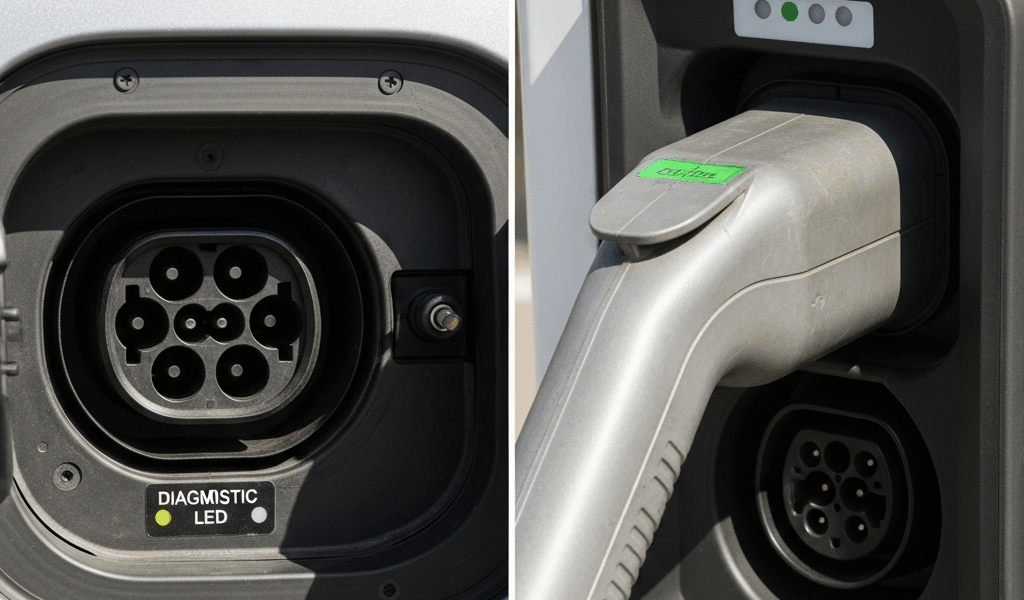
Why Your Car Won’t Recognize the Charger
EV charging has gotten complicated with all the conflicting forum advice flying around. As someone who spent three winters troubleshooting charging failures in a poorly insulated garage, I learned everything there is to know about why cars and chargers refuse to talk to each other. Today, I will share it all with you.
There are four reasons this happens. The pilot signal — a low-voltage handshake between your charger and your car — either fails to start, gets interrupted, or never finishes. The physical connector is dirty, wet, or damaged. The charger is stuck in a fault state or running old firmware. Or the problem lives entirely inside your vehicle: charge port, onboard charger, blown fuse. Most people never isolate which one applies and just start throwing random fixes at it. Don’t make my mistake.
Start Here — The 2-Minute Reset Check
Before you spiral, do this. Unplug the charging cable from both the wall unit and your car. Wait ten seconds — not two, actually ten. Plug the car end in first, then the wall. Push firmly until you feel or hear a solid click. That’s it. This simple re-seat fixes roughly one in four recognition failures because a loose connection quietly kills the pilot signal with zero visible drama.
Next, look inside your charge port. Open the flap, shine your phone’s flashlight in there, and hunt for moisture, lint, debris, or corrosion around the pins. Anything wet? Leave the port open for 30 minutes. Dust or lint? Use a compressed air can — the $8 keyboard-cleaning kind from Best Buy — and blow it out. Nothing metallic goes in there. Ever.
If you’re running a Level 1 charger off a standard 120-volt garage outlet, plug into a different outlet on a completely different circuit. A single failing outlet or tripped breaker won’t negotiate with your car properly. Level 2 units are hardwired or too heavy to move, so skip this step if that’s what you have.
Finally, power-cycle the charger itself. Flip the breaker feeding your Level 2 unit to OFF, count to 30, flip it back ON. This clears fault states that lock a charger into a silent, non-responsive mode. Some units have a physical reset button — use that if yours does. Wait until all indicator lights return to their resting state, usually a steady green or blue, before you try charging again.
Charger-Side Faults and How to Confirm Them
Frustrated by Pacific Northwest winters, I watched my garage flood slightly during a heavy December rainstorm — maybe two inches of standing water near the wall. That moisture triggered the GFCI built into my Level 2 unit, and the charger refused to communicate with my car for three full days. I blamed the car. I blamed the cable. I blamed myself. It was the GFCI the whole time.
Every EVSE has ground fault protection, either built directly into the unit or on the outlet behind it. When it trips — usually from dampness or a wiring ground fault — the charger goes completely silent. Your car sends out the handshake and gets nothing back. The fix is straightforward: if the outlet has a RESET button, press it. If the breaker has built-in GFCI protection, reset that instead. Trips again within seconds? Your space is too wet. Move the car outside or dry the area first.
Probably should have opened with this section, honestly — check the LED indicator on your charger. Most units flash specific patterns for specific fault states. On a ChargePoint Home Flex, a red or amber light usually means a ground fault or thermal problem. Grizzl-E units blink yellow when something’s wrong. Pull out the manual — or Google the model number and download it — and match whatever pattern you’re seeing to the fault code list. LED codes answer roughly 40 percent of “why won’t it charge” questions in under two minutes flat.
No fault light but the car still won’t recognize the charger after a full power cycle? The unit may have stopped sending a proper pilot signal. This happens when firmware goes stale or an internal relay gets stuck. Most modern chargers update over WiFi automatically, but check your brand’s app anyway. If an update is sitting there waiting, run it, then power-cycle the unit again before testing.
A stuck relay or failed control board is rare — but real. Charger showed a fault, you power-cycled it, the outlet tests fine, and your car still sees nothing? The charger needs service or outright replacement. Most home EVSE units carry a three-year warranty. Check yours before spending anything.
Car-Side Issues That Mimic a Charger Problem
But what is a car-side fault, exactly? In essence, it’s when the vehicle itself refuses to complete the charge handshake — even when the charger is working perfectly. But it’s much more than that. The onboard charger may have tripped an internal fuse. The charge port lock mechanism might be physically stuck. Or there’s a wiring fault somewhere between the port and the onboard charger module. That’s what makes EV diagnosis tricky — the same symptom can live in two completely different places.
Check your dashboard first. Some EVs throw a dedicated charge port warning light when an internal fault is detected — a small plug icon or an exclamation mark near the battery indicator. If you see that light, stop. The problem is vehicle-side, full stop. Call your dealer’s service line rather than spending another hour poking at the charger.
I’m apparently someone who owns two different EVs, and my Chevy Bolt works fine on my Grizzl-E Classic while my wife’s Ioniq 5 once refused that same unit for an entire week before I realized the port lock motor had jammed. Try a different charger if you can — a friend’s Level 2 setup, a public ChargePoint station, even a DC fast charger. If your car refuses every charger, including high-powered DCFC stations at 150 kW or above, the fault is inside the vehicle. Schedule service. If your car recognizes one charger but not another, you’ve just isolated the problem to that specific unit. That matters enormously.
Pay attention to whether the failure is consistent or random. Car sometimes recognizes the home charger, sometimes doesn’t — but works reliably on public networks? Suspect a wiring issue in your home panel or a moisture problem that comes and goes with temperature changes in your charge port connection.
When to Call an Electrician or Your Dealer
So, without further ado, let’s talk about when to stop DIYing this. You’ve hit that wall when one of three things is true. The EVSE shows no fault lights, completes its full startup cycle, but still fails to send the pilot signal to your car. The breaker protecting the charger trips every single time you attempt a charge — even after swapping outlets. Or your car refuses recognition from every charger you test, including public networks.
While you won’t need a complete electrical overhaul, you will need a handful of professional resources depending on which scenario applies. First scenario — the charger’s communication module has failed. Replacement runs $400 to $800 plus installation labor. Second scenario — your home panel or branch circuit wiring has a ground condition or voltage instability problem. Panel work runs $300 to $1,200 depending on what the electrician actually finds in there. Third scenario — your vehicle’s charge port or onboard charger circuit needs factory service. Expect $500 to $1,500 depending on the brand and whether the part is in stock.
An electrician’s diagnostic visit might be the best option, as EV charging requires stable voltage, correct grounding, and properly rated breaker amperage. That is because even a minor voltage sag or loose neutral connection can cause intermittent pilot signal failures that look exactly like charger problems. Diagnostic visits run $150 to $250. Worth every penny once you’ve exhausted the basics.
Most recognition failures — honestly, something like 70 percent — land in the first two sections. A re-seat, a port cleaning, a GFCI reset, or a firmware update solves it. Get to a professional only after you’ve actually isolated where the failure lives. Charger or car. Not “mystery.”


Stay in the loop
Get the latest northwestevcharge.com updates delivered to your inbox.