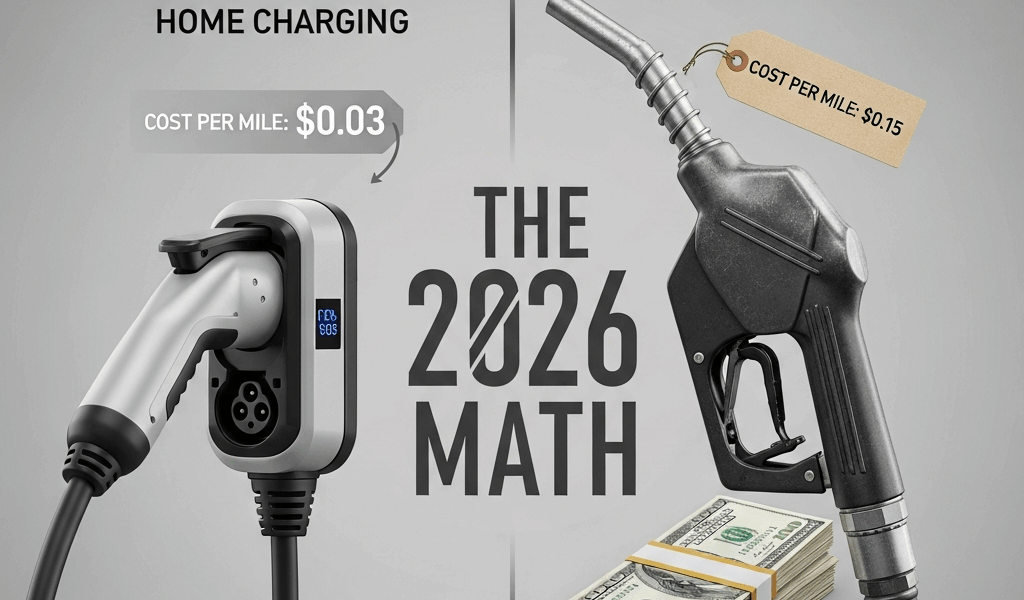
EV Home Charging Cost per Mile vs Gas — The 2026 Math
The EV charging cost per mile vs gas comparison looks pretty favorable on a national level. In the Pacific Northwest, it’s not even close. I’ve been driving a 2022 Chevy Bolt EUV out of Tacoma for the past two years, charging almost exclusively at home on a Level 2 ChargePoint Home Flex unit, and my monthly fuel spend has dropped so dramatically that I genuinely went back and audited my old bank statements to make sure I was remembering the number correctly. I was. The gap between what I was paying to fill a 2019 Honda CR-V and what I pay now to charge the Bolt is somewhere in the neighborhood of $80 to $90 every single month. Over a year, that’s real money. Not “latte factor” money. Actual money.
This article is going to walk through the 2026 math — national averages first, then PNW-specific numbers, then the charging location breakdown that most people skip, and finally the maintenance savings that make the total cost of ownership picture even more lopsided. If you’re on the fence about an EV and you live in Washington or Oregon, this might be the piece that tips you over.
The National Math — EV Wins by Half
Let’s start with the headline number, because it’s genuinely striking. Across the United States in 2026, the average cost to drive an EV is roughly 4 cents per mile. The average cost to drive a gas-powered car is roughly 13 cents per mile. That’s not a marginal difference. That’s a 69% reduction in fuel cost per mile driven.
Here’s how those numbers work out in practice. The average American drives about 1,200 to 1,300 miles per month. Run the math at 1,250 miles:
- Gas car at 13 cents per mile — $162.50 per month
- EV at 4 cents per mile — $50.00 per month
- Monthly savings — $112.50
- Annual savings — $1,350
Some widely-cited estimates peg the comparison at $61 per month for EV charging versus $132 per month for gas — which assumes slightly lower mileage and a blended efficiency figure across the current EV fleet. Either way, you’re looking at $70 to $112 in monthly savings and somewhere between $840 and $1,500 per year. The exact number depends on your specific vehicle, your local gas price, and how you’re charging.
The 13-cents-per-mile gas figure assumes a car getting about 28 miles per gallon and a national average gas price around $3.60 to $3.70 per gallon, which is a reasonable 2026 projection based on recent trends. The 4-cents-per-mile EV figure assumes a national average residential electricity rate of about 16 cents per kilowatt-hour and an EV consuming roughly 3 to 3.5 miles per kWh — which is close to real-world efficiency for popular models like the Tesla Model 3, the Hyundai Ioniq 6, and the Chevy Bolt.
Those are solid national averages. But national averages hide a lot of regional variation, and that variation matters enormously when you’re trying to figure out what your specific electricity bill will look like after you plug in an EV in your garage in Bellingham or Portland.
Pacific Northwest Rates Make It Even Better
This is the part most national comparison articles completely miss, and honestly it’s the most important section for anyone reading this from Washington or Oregon. Probably should have opened with this section, honestly.
The Pacific Northwest has some of the cheapest residential electricity rates in the entire country. Hydroelectric power from the Columbia River system — Bonneville Dam, Grand Coulee, and a dozen others — keeps rates artificially low compared to the national average. Here’s what that looks like in concrete numbers.
Washington State Rates
Puget Sound Energy customers in 2026 are paying around 10 to 11 cents per kWh for residential electricity in the first tier. Seattle City Light is even cheaper — around 9 to 10 cents per kWh for the first tier of residential use. Snohomish County PUD comes in around 9 to 10 cents as well. These are all meaningfully below the 16-cent national average.
Run the EV charging math with a 10-cent rate instead of 16 cents:
- Bolt EUV gets roughly 3.5 miles per kWh in real-world driving
- At 10 cents per kWh, that’s 2.86 cents per mile — call it 3 cents per mile
- At 1,250 miles per month, that’s $37.50 per month to charge
Compare that $37.50 to what a 28-MPG gas car costs at Washington’s average gas price — which has been running around $3.80 to $4.00 per gallon in 2025 and 2026, particularly in the Puget Sound region. At $3.90 per gallon and 28 MPG, you’re spending $174 per month on gas for those same 1,250 miles.
That’s a difference of $136.50 per month in Washington. $1,638 per year.
Oregon Rates
Oregon is slightly less dramatic but still well below the national average. Portland General Electric customers pay around 11 to 12 cents per kWh. Pacific Power comes in around the same range. Eugene Water & Electric Board is among the cheapest in the state at around 9 to 10 cents. Oregon’s gas prices track close to Washington’s — Portland usually hovers around $3.70 to $3.90 per gallon depending on the month.
At 12 cents per kWh and 3.5 miles per kWh, Oregon EV drivers are paying about 3.4 cents per mile. At $3.80 gas and 28 MPG, gas costs about 13.6 cents per mile. That’s still a four-to-one ratio in favor of electricity.
Oregon EV drivers in Portland are saving roughly $125 per month compared to a comparable gas car. Around $1,500 per year.
A Word on Time-of-Use Rates
Both PSE and PGE offer time-of-use rate plans that reward overnight charging with even lower rates. PSE’s EV-specific rate plan drops to around 6 to 8 cents per kWh during off-peak overnight hours. If you set your charger to start at midnight and finish by 6 a.m. — which is trivially easy with virtually every Level 2 home charger on the market today — you can push that per-mile cost down to 2 cents or under. At that point, you’re basically driving on rounding errors.
I switched to PSE’s time-of-use plan about eight months into EV ownership and dropped my charging cost by another $12 to $15 per month. Small number, but it’s money for doing essentially nothing.
Home Charging vs Public Charging Cost Difference
Here’s something the simple “EV vs gas” comparison often glosses over: where you charge determines your cost more than which EV you drive. This is not a minor footnote. It’s a foundational point that changes the entire economics of EV ownership.
Home Level 2 Charging — The Gold Standard
Charging at home on a Level 2 setup — which means a 240-volt charger, typically a 32- or 48-amp unit like the ChargePoint Home Flex, the Wallbox Pulsar Plus, or the Emporia EV Charger — gives you access to your utility’s residential rate. In the PNW, that’s 9 to 12 cents per kWh. This is where the 2 to 3 cents per mile figures come from.
The upfront cost of a Level 2 home charger runs $400 to $700 for the unit itself, plus $200 to $600 for electrician installation depending on your panel setup and distance from the garage. Total call it $600 to $1,300 one-time. That cost gets paid back in fuel savings within 6 to 12 months for most PNW drivers.
Public Level 2 Charging — Moderate Cost
Public Level 2 stations — the kind you find at grocery stores, libraries, and office parking garages — typically charge by the hour or by the kWh. Blink and ChargePoint networks in the Pacific Northwest usually run $0.10 to $0.20 per kWh at public Level 2 stations, or $1 to $2 per hour. That’s still cheaper than gas, but noticeably more expensive than home charging. Figure 5 to 6 cents per mile at a public Level 2 station in the PNW.
If you can charge at home most of the time and use public Level 2 as a top-up, your blended rate stays very low.
DC Fast Charging — The Trap
This is the part that surprised me when I first started looking at the numbers. DC fast charging — the kind that can add 100 miles in 20 to 30 minutes — is significantly more expensive per kWh than home charging. Electrify America stations in Washington and Oregon are currently pricing at $0.43 per kWh for non-members. Tesla Superchargers outside the Supercharger network membership are in the $0.40 to $0.48 per kWh range.
At $0.43 per kWh and 3.5 miles per kWh, you’re paying 12.3 cents per mile. That’s almost exactly the same as gas in a 28-MPG car at $3.45 per gallon. At $0.48 per kWh, you’re paying 13.7 cents per mile — more expensive than gas.
Burned by this once on a road trip down to Eugene when I didn’t have a membership plan set up. I was paying Electrify America’s casual rate and actively getting worse cost-per-mile than my old CR-V would have. Lesson: set up the membership tier on whatever fast charging networks you use regularly. It typically drops the per-kWh rate to $0.25 to $0.32, which gets you back to 7 to 9 cents per mile — still not as good as home charging, but reasonable for road trip use.
The principle is straightforward: home charging is your baseline, public Level 2 is acceptable, and DC fast charging is for emergencies and road trips — not a daily strategy.
The Full Cost Picture — Maintenance Saves Too
Focused purely on fuel costs, the PNW EV driver saves $1,200 to $1,600 per year. But that’s not the whole story, and the maintenance angle deserves serious attention.
Oil Changes Gone
The average American spends $120 to $200 per year on oil changes — more if they’re driving a truck or a European car. EVs have no engine oil. No filter. No oil change. Ever. That’s $120 to $200 back in your pocket annually, immediately, with no math required.
Synthetic oil changes for my old CR-V at the Honda dealer ran $89.95 every 6,000 miles. I was getting four of those per year. $360 per year in oil changes alone. Gone.
Brake Pads Last Two to Three Times Longer
Regenerative braking — the system that recaptures energy when you lift off the throttle and slow the car — means EV friction brakes barely work at all in normal driving. The brake pads on a Bolt EUV, a Model 3, or an Ioniq 6 routinely last 80,000 to 100,000+ miles. Gas car pads typically wear out at 30,000 to 50,000 miles depending on driving style.
A front brake job on a typical gas car runs $250 to $400. If you do it once every 40,000 miles on a gas car versus once every 100,000 miles on an EV, the savings over a 200,000-mile vehicle lifespan are substantial. Figure $600 to $800 in brake savings over that span.
The Transmission, the Coolant, the Spark Plugs
EVs have no transmission fluid to change, no spark plugs to replace, no timing belt, no serpentine belt. The maintenance schedule on a Bolt EUV is almost embarrassingly short. Tire rotations. Cabin air filter. Wiper blades. That’s roughly it for the first 100,000 miles. The 30,000-mile, 60,000-mile, and 90,000-mile service intervals that add up to $800 to $1,200 on a gas car simply don’t exist.
Third-party studies have consistently found that EV maintenance costs run 30 to 40 percent lower than equivalent gas vehicles over a 5-year ownership period. Consumer Reports data from 2023 and 2024 pegged EV maintenance costs at about $0.031 per mile versus $0.061 per mile for gas — another 3 cents per mile in EV’s favor.
The Total Cost of Ownership — PNW Edition
Add it all together for a Pacific Northwest driver doing 15,000 miles per year:
- Fuel savings — $1,400 to $1,600 per year
- Oil change elimination — $120 to $360 per year
- Reduced maintenance (brakes, transmission service, plugs) — $200 to $400 per year amortized
- Total annual savings — $1,720 to $2,360 per year
At $2,000 per year in combined savings, an EV pays down its purchase price premium — typically $3,000 to $6,000 over a comparable gas vehicle before any federal tax credits — in 1.5 to 3 years. With the federal EV tax credit still at $7,500 for qualifying vehicles and buyers in 2026, many PNW buyers end up in a position where the EV is cheaper to purchase outright, then cheaper to run every month after that.
That’s not a marginal win. That’s a structural cost advantage that compounds every month you own the car.
The honest summary: if you live in Washington or Oregon, charge primarily at home, and drive a reasonable number of miles per year, an EV in 2026 is almost certainly the cheaper choice across fuel, maintenance, and total cost of ownership combined. The national math already favors EVs. The PNW math makes the argument almost unanswerable.


Stay in the loop
Get the latest northwestevcharge.com updates delivered to your inbox.