
The drive from Seattle to Portland is 174 miles door to door. If you’re in a modern EV with 250+ miles of EPA range, you can do this without stopping for a charge — especially if you leave Seattle full. But if you’re starting with 60%, driving in winter, or just want the peace of mind of knowing exactly where to pull off, here are the specific stops on I-5, ranked by charging speed and what’s actually nearby.
Can You Drive Seattle to Portland Without Stopping?
Short answer: yes, in most modern EVs. A Tesla Model 3 Long Range, Chevy Equinox EV, Hyundai Ioniq 6, or any EV with 240+ miles of real-world range can make it nonstop in moderate weather if you start full.
The math gets tighter in two situations: cold weather (below 40°F cuts range 20-30%, which on a 280-mile car means you’re down to ~195 miles — enough, but barely), and highway speeds. I-5 runs at 70+ mph for most of the route, and highway driving at that speed is significantly less efficient than the mixed driving the EPA range estimate assumes. Driving at 75 mph in winter with the heat on is when a stop starts making sense.
Bottom line: if it’s above 50°F and you leave Seattle above 85%, skip every stop. If it’s winter or you’re running anything below 70%, pick one stop from the list below and plan it in.
Charging Stop 1 — Tacoma (South Hill / Pacific Ave)
If you’re leaving Seattle’s south end and want to top up before the open highway stretch, Tacoma is your first real option. The Electrify America station at the Tacoma Walmart on 38th St has multiple 150kW CCS stalls — fast enough that 15 minutes gets you 50-70 miles depending on your car.
There’s also a ChargePoint Express cluster near the Tacoma Mall on South 38th — these run at lower power (around 50kW) but there are usually more stalls available. The EVgo at the Tacoma Walmart Supercenter on Pacific Ave is another solid option with CCS and CHAdeMO.
Food while you charge: The Tacoma stop area has the usual fast casual options near the Walmart. If you have 20-30 minutes, the Harbor Lights restaurant and the Tacoma waterfront are a 10-minute drive from the South Hill Walmart EA station — worth it if you’re not in a hurry.
Charging Stop 2 — Chehalis (Exit 79)
Chehalis is the natural midpoint — Exit 79 puts you roughly halfway between Seattle and Portland. This is the stop for people who want to break the drive in the middle and grab food.
The EVgo station in Chehalis is right between the Home Depot and the Walmart at Exit 79. Easy to find, easy to pull in and out. Multiple CCS stalls. Pricing is standard EVgo rates — by the minute for non-members, by the kWh with a membership.
What’s nearby at Exit 79: A full range of fast food (McDonald’s, Subway, Taco Bell, Panda Express) all within walking distance of the EVgo station. If you want to sit down, Burgerville is a local Pacific Northwest chain that’s a notch above fast food. The Chehalis-Centralia Railroad & Museum is 5 minutes away if you’ve got curious kids in the car.
Charge time at the EVgo: Budget 20-25 minutes for 80-100 miles of range on most CCS vehicles. Don’t charge past 80% here — you won’t need it, and charging slows significantly above 80%.
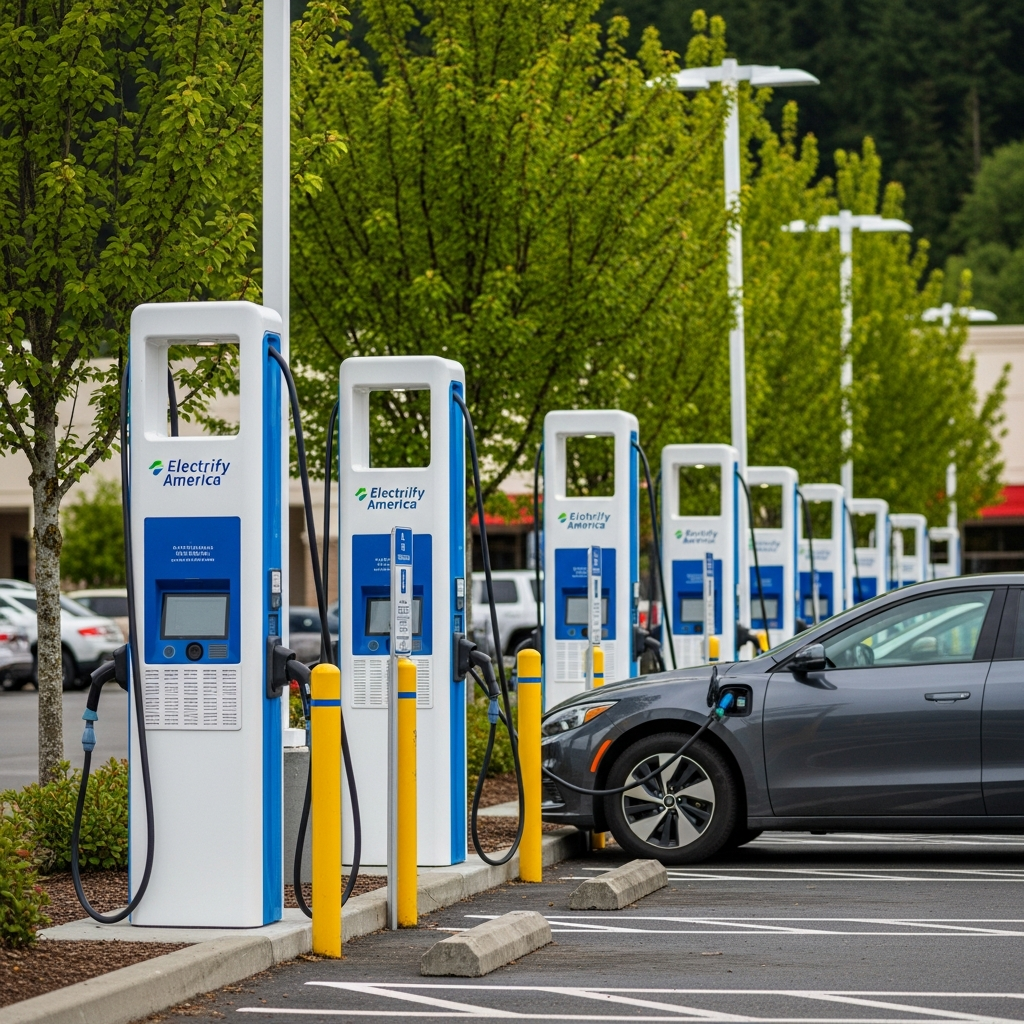
Charging Stop 3 — Kelso/Longview (Electrify America at Three Rivers Mall)
Exit 39 takes you to the Three Rivers Mall in Kelso, where Electrify America has a multi-stall station. This is the last major stop before the Oregon border — about 50 miles from Portland.
The EA station here runs up to 150kW per stall. It’s a legitimate fast charger, not the underpowered Level 2 units that some mall chargers default to. If your car can accept 100kW+, you’ll see real speed here.
Three Rivers Mall has a food court, a Sears (or whatever is in that anchor space now), and a handful of mid-range restaurants. It’s a comfortable stop rather than an exciting one, but the charger works and the parking is easy.
One note: EA stations require a app or the touchscreen on the unit to activate. Download the Electrify America app before you leave Seattle and add a payment method. Fumbling with app setup while your car is sitting at the charger wastes your charging time.
Crossing into Oregon — Wilsonville EA (Best Stop on the Route)
If you’re going to stop once on the I-5 corridor, make it Wilsonville. The Electrify America station in Wilsonville, Oregon is consistently rated one of the best on the West Coast. Eight stalls at up to 350kW maximum, which means 150-250kW actual delivery on most non-Porsche EVs — and that’s still very fast.
What makes Wilsonville special: there’s a Starbucks attached, restrooms are right there, and the whole setup feels designed for road-tripping rather than an afterthought in a parking lot. Twenty minutes here, a coffee, a bathroom break, and you’re fully recharged for the Portland leg.
Wilsonville is 17 miles south of Portland. If you stop here, you arrive in Portland with a full battery and can skip hunting for urban charging immediately after your drive.
Arriving in Portland — Where to Charge in the City
Once you’re in Portland, the charging network is solid. EVgo has a Portland City Guide with multiple stops near major attractions. The Lloyd Center mall area has public charging. The Pearl District has ChargePoint stations in several parking garages.
If you’re staying in a hotel downtown, call ahead and ask about destination charging — the Waterfront Marriott has NEMA 14-50 outlets accessible via Smart Park a block away. Hotel DeLuxe, Hotel Modera, and Hotel Monaco have all had EV charging options available for guests.
For overnight charging in Portland, the PGE neighborhood chargers ($0.12/kWh) scattered through residential neighborhoods are an economical option. They’re slower (Level 2) but if you’re parked for 8 hours, that’s 80-100 miles of range added overnight for a couple of dollars.
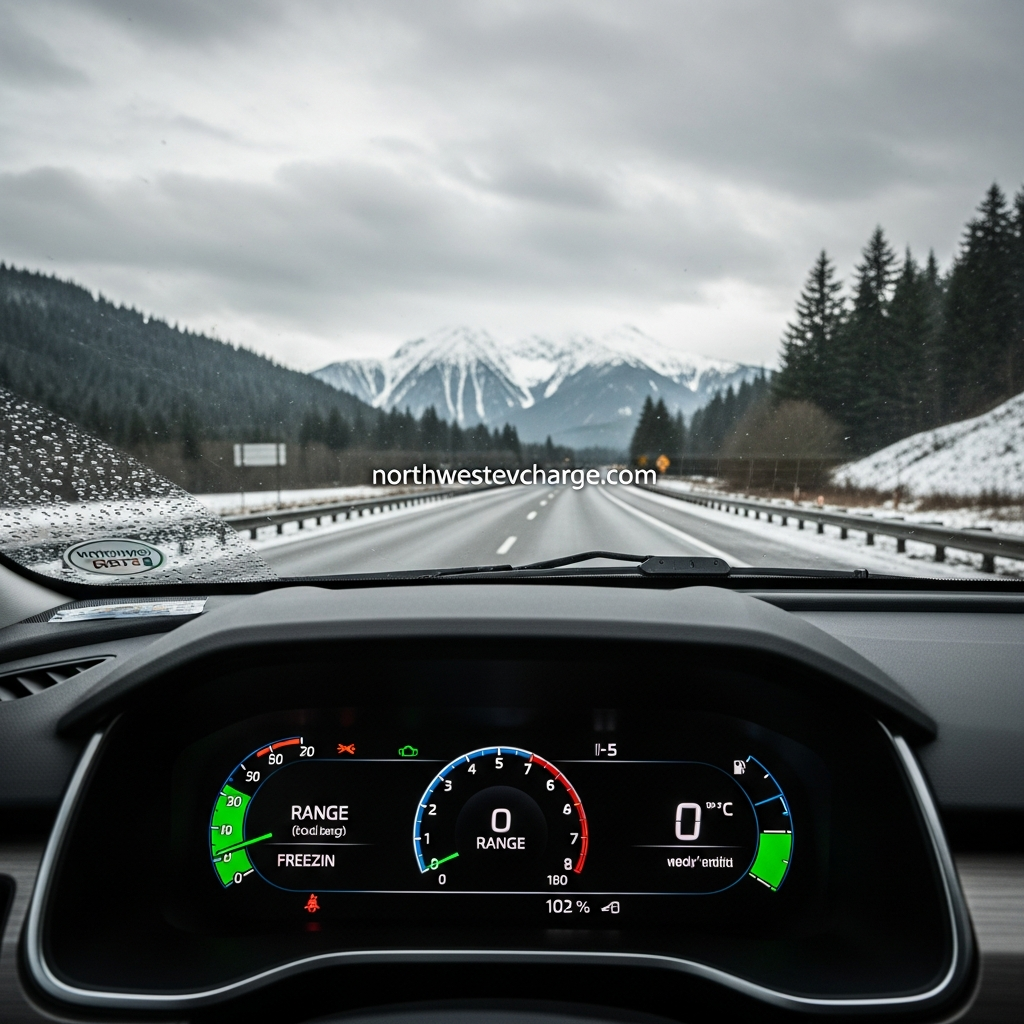
Winter Driving the I-5 Corridor — Extra Planning Tips
The Seattle to Portland run in winter (November through February) deserves specific planning. A few things that matter:
Precondition your battery before you leave. Both Tesla and most non-Tesla EVs allow you to set the cabin temperature while still plugged in. Pre-warming the car uses grid electricity, not battery, and means your battery is at optimal temperature when you start driving.
Plan for 20-25% less range. A car rated at 280 miles in summer might deliver 210-220 in real 35°F winter conditions with heat running. Run that math before you decide to skip the Chehalis stop.
Check station status before you leave. PlugShare shows recent check-ins. If the EVgo in Chehalis had three “broken” reports in the last 24 hours, skip it and plan for Kelso instead. A broken station in winter is a worse problem than in summer — you have less buffer.
The Electrify America app shows real-time stall availability. Check it 20 minutes before your arrival at each stop — if all stalls are occupied, you can add a few minutes to your trip plan rather than arriving and waiting.
The Seattle to Portland drive in an EV is genuinely pleasant when you plan it right. The I-5 corridor is one of the better-served charging routes on the West Coast. Know your stops, check the weather, and you’ll arrive with range to spare.


Stay in the loop
Get the latest northwestevcharge.com updates delivered to your inbox.