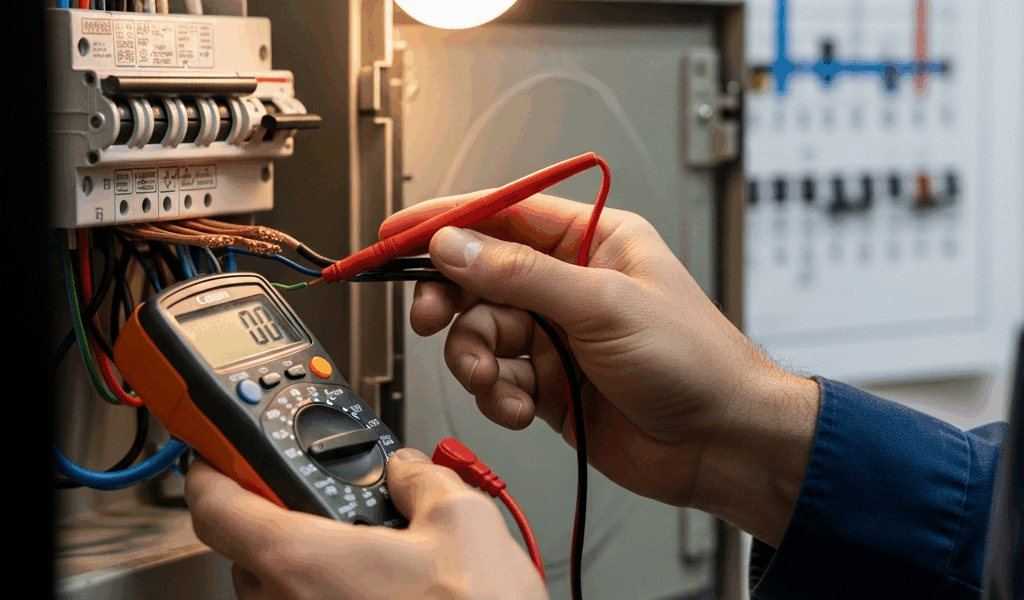
Why the Wrong Wire Gauge Is a Real Problem
EV charger installation has gotten complicated with all the misinformation flying around — but wire gauge isn’t a gray area. Get it wrong and you’re not dealing with a cosmetic fix. You’re dealing with a legitimate fire hazard hiding inside your walls.
Undersized wire heats up. Simple as that. A Level 2 charger pulling 40 or 50 amps through 10 AWG wire — when the job actually called for 8 or 6 AWG — generates sustained heat inside that conduit every single time you plug in. That heat degrades insulation over months, not years. Breakers start tripping. Or worse, they don’t trip. And then you’ve got a problem that doesn’t announce itself until something catches.
In Washington and Oregon, wrong wire gauge is one of the most common reasons EV charger installs get red-tagged during inspection. I’ve talked to electricians who pulled permits, did the work, and had inspectors flag it immediately on-site. Now you’re scrambling — either rewire the whole run or leave an open violation that shows up the moment any home inspector walks through. Neither option is fun.
Probably should have opened with this section, honestly. The safety angle is the whole point.
How to Tell If Your Wire Gauge Is Wrong
Start by reading what’s actually printed on your wire jacket. That’s the diagnostic move that catches most problems before they turn into $2,000 surprises.
Look for markings stamped directly on the plastic sheath — “8 AWG,” “6 AWG,” “10 AWG.” It’s right there. Then match that number against your charger specs and your breaker size. Most 40-amp EV circuits require 8 AWG minimum. Most 50-amp circuits require 6 AWG. Those aren’t suggestions — they’re code minimums.
But what is ampacity, exactly? In essence, it’s the maximum current a wire can safely carry without overheating. But it’s much more than that, because material, temperature rating, and run length all shift the number in ways that aren’t obvious.
Here’s where Pacific Northwest homes get tricky. If your house was built before 1980, pull back a section of jacket and check whether the wire is aluminum or copper. I learned this the hard way when a neighbor’s 1975 rambler — a ranch-style house on SE Holgate in Portland — turned out to have aluminum wiring running from a Federal Pacific panel. The electrician we called had to throw out the original ampacity math entirely and start over. Aluminum 8 AWG is not equivalent to copper 8 AWG. You need one gauge larger with aluminum — so where copper calls for 6 AWG, aluminum needs 4 AWG. Most installers miss this completely on older homes. Don’t make my mistake.
Also measure the actual run from your breaker panel to the charger location. A 40-foot garage run creates voltage drop that a 10-foot run never sees. Long runs to detached structures compound the undersizing problem fast. The farther the distance, the heavier the wire needs to be.
- Read the wire jacket printing carefully
- Confirm charger amperage requirements from the manual or nameplate
- Check breaker size at the panel
- Note the run distance from panel to charger location
- If aluminum wiring — verify you’re using aluminum-rated ampacity tables, not copper tables
What Happens If You Leave It and Just Hope
I get it. Rewiring is disruptive and expensive and nobody wants to hear they have to do it. But leaving an undersized circuit alone has a way of finding you eventually — usually at the worst possible moment.
Your next home inspection will flag it. Any competent inspector will catch the mismatch between breaker size and wire gauge, or they’ll find the original failed inspection in the permit history. That becomes a disclosure issue immediately. It chips away at your home value and complicates sale negotiations in ways that are genuinely hard to predict. Some lenders require it corrected before they’ll close.
Insurance is its own problem. Fire marshal traces a house fire back to an undersized EV charger circuit — your claim gets denied. The installation violates code. You’re liable. That’s not a hypothetical.
And day-to-day, you’re living with nuisance tripping, a charger that thermal-derates on hot August afternoons and leaves your car half-charged, and insulation quietly breaking down inside conduit you can’t see.
Step-by-Step Fix Depending on How Bad It Is
Scenario One — Wire Is Slightly Undersized and Run Is Short
So, without further ado, let’s dive in — starting with the situation most homeowners are actually in.
If you’re running 10 AWG on a 40-amp circuit but the distance is under 20 feet and you’ve got copper wiring in a post-1980 home, two workarounds exist. Neither is perfect. Both are real options that some jurisdictions allow.
First option: derate the charger. Most Level 2 chargers — ChargePoint Home Flex, Emporia Level 2, Grizzl-E Classic, take your pick — let you dial down the maximum amperage through the app or DIP switches. Cap it at 32 amps instead of 40. 10 AWG handles 32 amps safely on shorter runs. You lose maybe 20% of charging speed. You eliminate the immediate fire risk. You still need to update your permits and get it inspected under the new amperage — that part isn’t optional.
Second option: install a smaller breaker. If the circuit was originally sized for 50 amps but your wire is actually 8 AWG, dropping the breaker to 40 amps puts you back in code. This requires opening the panel. That means a licensed electrician signs off. Not a DIY move — at least if you’re in Washington or Oregon, where inspectors specifically check for exactly this kind of shortcut.
Scenario Two — Wire Is Significantly Undersized or Run Is Long
10 AWG on a 50-amp circuit. A 60-foot run with undersized wire. Aluminum wiring that got calculated on copper tables. Any of these — you’re rewiring. No workaround passes inspection or stays safe long-term.
A full conduit run replacement from panel to charger typically runs $1,200 to $2,800 in the Portland and Seattle markets. That range moves depending on distance, wall access, and whether anyone has to touch concrete. The wire itself — maybe $200 to $400 for a 50-foot run of 6 AWG copper THWN-2. The labor is the actual cost driver.
Critical part: if the original installation was ever permitted — and it should have been — the corrected installation needs its own permit and inspection. Washington and Oregon both require permits for new EV charger circuits of 40 amps or higher. Skip the permit on the fix and you create documentation problems when you sell. Future buyers’ lenders want proof of permitted work. It’s not technically optional, and in practice, it really isn’t optional.
When to Call an Electrician Versus DIY This
A lot of homeowners ask, after getting an inspection failure notice in hand, whether they can just pull the old conduit and run new wire themselves. The answer depends entirely on what you’re actually touching.
Work that stays outside the breaker panel — replacing the conduit run and wire from the panel disconnect to the charger, nothing more — is lower-risk territory. If you’re comfortable working with 3/4-inch EMT, a fish tape, and pulling 6 AWG through a 50-foot run, you can save real labor costs there. Still get it permitted. Still hire a licensed electrician to make the final connections at the panel or breaker. That last part matters.
If the original installation required opening the panel or adjusting breakers — stop. Call a licensed electrician. Panel work is not homeowner territory in either state, full stop. I’m apparently someone who thought I understood panels until I didn’t, and a $180 service call was a lot cheaper than the alternative. Same rule applies if you’re dealing with aluminum wiring anywhere in the circuit. That stuff requires specialized termination hardware — Ideal 65 Wire Connectors, anti-oxidant compound, CO/ALR-rated receptacles — and experience sizing it correctly.
The permit is also non-negotiable. Washington and Oregon both track EV charger permits by address. Skip it and you’re manufacturing a liability that surfaces during any appraisal, refinance, or home sale. That’s what makes getting this done right endearing to us Pacific Northwest homeowners — once it’s permitted and inspected, it’s actually done.
Wrong wire gauge feels like a technicality until your breaker panel is warm to the touch at midnight. Catching it early, fixing it properly, and pulling the permit the second time around — that’s the move.

Stay in the loop
Get the latest northwestevcharge.com updates delivered to your inbox.