Do You Actually Need a Permit to Install an EV Charger
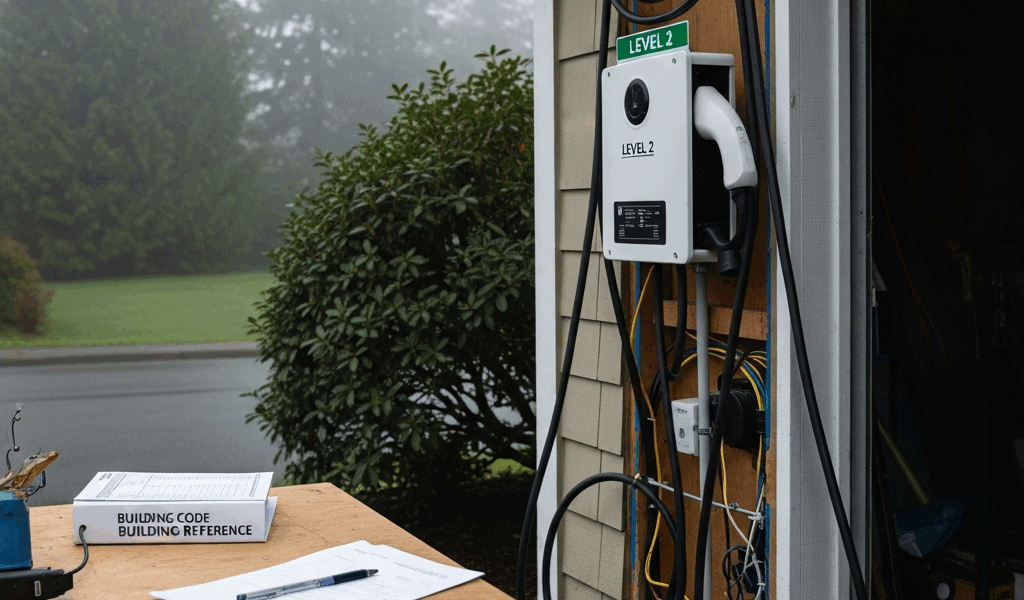
EV charger permits have gotten complicated with all the misinformation flying around. Short answer: yes. Almost certainly yes — at least if you’re installing a Level 2 charger with a new 240-volt dedicated circuit.
As someone who spent three months going down this rabbit hole, I learned everything there is to know about EV charger permits in the Pacific Northwest. My neighbor casually mentioned he’d “just had a guy come out and install one” — no permits, no inspections, nothing. That one offhand comment sent me spiraling. Today, I will share it all with you.
Here’s what nobody tells you upfront. A Level 2 charger — the kind that charges a Tesla Model 3 or Chevy Bolt in 6–10 hours instead of a painful 24 — needs a dedicated 240V circuit. That circuit runs straight from your electrical panel. New conduit. New breakers. New load calculations. Any licensed electrician doing this work is legally required to pull a permit in virtually every incorporated area across Washington, Oregon, and Idaho. Inspections happen twice: once after the rough wiring is done, once after the charger is mounted and connected.
Level 1 chargers are a different story. Plugging a basic 120V charger into an existing outlet? No permit needed. That’s just standard household electrical use. But Level 1 is painfully slow — maybe 3 miles of range per hour. Most people want Level 2. Most people need Level 2.
Skip the permit and you’re gambling with three things simultaneously: a failed home inspection when you eventually sell, an insurance claim denial if something catches fire, and the full cost of tearing out and redoing the installation from scratch. I’ve talked to homeowners in Bend and Portland who learned exactly this. Don’t make my mistake of thinking it won’t happen to you.
How Permit Rules Differ in Washington Oregon and Idaho
Permits aren’t national. They’re hyper-local. The Pacific Northwest is a genuine patchwork, and treating it like one unified rulebook will get you in trouble.
Washington State
Washington has no statewide EV charger permitting standard. Each Authorized Jurisdictional Authority — your city or county, essentially — sets its own rules. Seattle requires permits for any new 240V circuit. Same with Tacoma, Bellevue, Kirkland. Most incorporated cities fall in line. Unincorporated King County gets murkier by district. Spokane County runs stricter than a lot of rural eastern Washington counties. Some rural island counties barely have the staff to enforce inspections — but that’s not the same as the rule not existing. Compliance just gets spotty out there.
Call your city or county building department before you hire anyone. They’ll give you a straight answer in under five minutes. Permit cost typically lands between $75 and $150.
Oregon
Oregon runs on the Oregon Residential Specialty Code — ORSC for short. New circuits require permits. Always. Portland, Eugene, Salem — it’s consistent statewide in a way Washington simply isn’t. Oregon’s building department is generally responsive online, and several counties have streamlined the EV charger process specifically. Some are even offering expedited permits now to push adoption numbers up. Permit cost usually runs $50–$120, sometimes less for a clean install that doesn’t require a panel upgrade.
But what really makes Oregon permit compliance a no-brainer? Energy Trust of Oregon rebates require proof of a permitted install. We’re talking $300–$500 back in your pocket — gone if you cut corners on the paperwork.
Idaho
Idaho is the wildcard here. Boise and Meridian enforce permits for any new 240V installation, full stop. Mountain Home and the rural counties? Less consistent. Some building departments are genuinely understaffed and enforcement gets loose. That’s a terrible reason to skip a permit. If you’re anywhere in the Boise metro area, treat it exactly like Washington and Oregon — get the permit, get the inspection, keep the documentation.
What Happens If You Skip the Permit
Frustrated by the cost and timeline, plenty of homeowners convince themselves skipping the permit is the smart play. Faster. Cheaper upfront. I watched it backfire twice in my neighborhood alone. That’s what makes permit horror stories so enduring among EV owners — they keep happening to people who thought they were being clever.
Scenario 1: The Home Sale
A Portland homeowner disclosed their charger installation during a sale. The buyer’s inspector flagged unpermitted work during the walkthrough. The seller faced three options: disclose the violation in writing, accept a $5,000 price reduction, or hire a licensed electrician to tear it out and reinstall everything with a proper inspection. All of this unfolded between offer and close. Escrow held up. Stress went through the roof. Nobody wants that.
Scenario 2: The Insurance Claim
Burned — literally — by an electrical fire, a Bend homeowner discovered their unpermitted charger installation was grounds for a full claim denial. The insurer pointed to the missing inspection documentation. That was it. Claim denied. They ended up with new wiring, a new charger, a higher premium, and zero reimbursement. The original permit would have cost maybe $100.
Scenario 3: Future Panel Work
Eventually you’ll need a panel upgrade. Older homes with maxed-out amperage hit this wall fast when an EV enters the picture. The electrician you hire will ask immediately whether the charger was permitted. When you say no, they’re obligated to report it. Suddenly you’re redoing work you thought was finished years ago — on your own dime.
Washington and Oregon utility rebates require proof of a permitted install too. If you’re counting on that $300–$500 to offset installation costs, skipping the permit means skipping the check. Simple math.
How to Pull a Permit for an EV Charger Install
Probably should have opened with this section, honestly. The process is straightforward — usually 1–3 weeks from application to final inspection. So, without further ado, let’s dive in.
- Contact your local building department. Call or go online. Tell them you’re installing a Level 2 EV charger with a new 240V circuit. Ask for their permit application and any jurisdiction-specific requirements. Five-minute conversation, tops.
- Provide basic details. Charger model — Tesla Wall Connector Gen 3, ChargePoint Home Flex, whatever you’ve chosen — amperage (usually 40–60 amps), panel location, and whether a panel upgrade is on the table. Most departments use a single one-page form for this.
- Let your electrician pull it. Licensed electricians pull permits constantly. Most fold the $75–$150 permit fee right into their initial quote. If yours balks at pulling a permit, hire someone else immediately.
- Schedule the rough-in inspection. After the new circuit is run from the panel but before the charger is mounted, the inspector comes out. Usually 30 minutes. They check wire gauge, breaker sizing, conduit routing, panel work — the whole picture.
- Schedule the final inspection. Charger mounted, connected, tested. The inspector verifies everything matches the permit documents and the unit is functioning correctly.
- Get your final sign-off. You receive an inspection report and a final permit card. Keep this. File it with your home records. You’ll want it for resale.
Total cost: $50–$200 depending on jurisdiction. Total time: 2–4 weeks. Effort on your end: minimal — at least if your electrician has done this before in your specific city or county.
Questions to Ask Your Electrician Before They Start
These questions will tell you within the first five minutes whether you’re working with someone who actually knows the local rules.
- Will you pull the permit or do I? Reputable electricians pull it themselves. If they expect you to handle it, that’s a red flag worth taking seriously.
- Is this job permit-required in my jurisdiction? A qualified electrician already knows. “I think so” or visible uncertainty? Ask for a reference from a recent local install in your specific city.
- Will you schedule inspections and be on-site for them? Your electrician should coordinate with the building department directly and attend every inspection to address findings in real time.
- Does my panel need an upgrade? This requires a separate permit and is often the hidden cost nobody mentions upfront. A qualified electrician uses a clamp meter — something like a Fluke 376 FC — to assess available amperage before quoting anything.
- Is the permit fee bundled into your quote or billed separately? Some electricians bundle it; others invoice it separately. Either is fine — you just need to know which.
I’m apparently more paranoid about electrical work than most of my neighbors, and that paranoia works for me while skipping inspections never has. Getting a permit for an EV charger install isn’t optional in the Pacific Northwest. It’s the difference between a clean, documented install and a liability that follows your house for years. Do it right the first time.


Stay in the loop
Get the latest northwestevcharge.com updates delivered to your inbox.