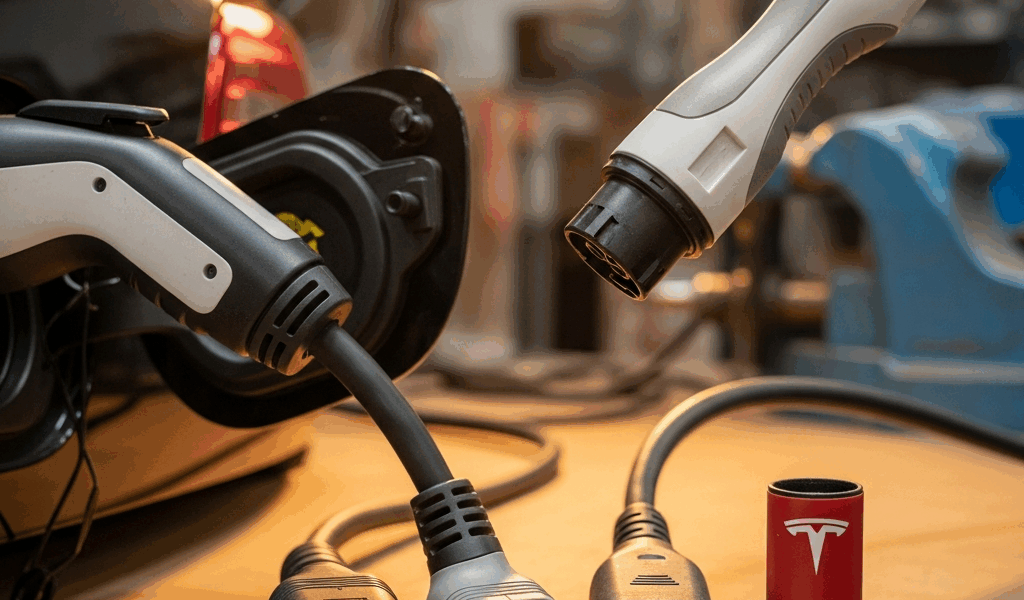
Why Your EV Charger and Car Outlet Don’t Match
EV charging has gotten complicated with all the connector confusion flying around. You’ve probably stared at a cable end and an inlet port that clearly weren’t made for each other — standing in your garage, charger installed, car sitting right there, going absolutely nowhere. That was me last spring. That’s a lot of people right now.
Here’s the short version of why this keeps happening. The U.S. spent years running on the J1772 standard for Level 2 home and public charging. Then Tesla’s NACS connector — North American Charging Standard — became the industry default, and Ford, GM, Volkswagen, and others started switching their vehicles over. Charger installed before 2023? Almost certainly J1772. New vehicle from 2024 or 2025? Probably NACS. That gap between old infrastructure and new cars is where the frustration lives.
Probably should have opened with this section, honestly — it would have saved people a lot of grief before dropping $500 to $2,000 on installation without checking compatibility first. So. Today I’ll share everything there is to know about diagnosing and fixing the mismatch. Let’s get into it.
Step 1 — Figure Out Which Connector You’re Actually Dealing With
Before anything else, you need to know what you’re looking at. Not what you think you have. What you actually have.
The J1772 connector is the older standard. Pick up the cable end attached to your wall unit. Round body, roughly the size of a coffee mug opening, with a paddle-shaped latch that clicks in and locks. That’s J1772. Chevrolet Bolts, Nissan Leafs, Volkswagen ID.4s, and older Teslas from before the switchover all use this inlet on the car side. You’ll recognize the car-side port immediately — round receptacle, same general shape as the cable.
NACS looks completely different. Smaller, rectangular — think a narrower household plug that sits flush against the body panel. Clean, compact. New Teslas use it. So does the 2024+ Ford F-150 Lightning, the GMC Sierra EV, and most vehicles launching post-2024. The cable end on a NACS charger mirrors that same rectangular shape.
One thing that matters enormously here: hardwired chargers bolt directly to your electrical panel with a fixed cable. You can’t unplug the connector end from the wall unit the way you can with a standard plug-in charger. If you’ve got a hardwired unit with the wrong connector, a simple adapter might not be enough — you may need the cable assembly replaced or the whole unit swapped out. Keep that in mind before you order anything.
Step 2 — Check Whether an Adapter Actually Solves It
For most people? An adapter is the cheapest fix by a wide margin. Fast, too.
Tesla owners or anyone running a Tesla Wall Connector whose vehicle needs J1772 — Tesla sells an official adapter for around $45. Plugs into the NACS outlet, gives you J1772 on the other end. Non-Tesla owners keep them in the glovebox for road trips and public charging stops. Solid little piece of kit.
The reverse is trickier. J1772 home charger, new Ford or GM vehicle with NACS inlet. Third-party manufacturers — Lectron and Aion are the names I keep seeing on legitimate EV forums — make NACS-to-J1772 adapters ranging from about $80 to $200. I’ve watched neighbors run these successfully for months. But the brand vetting matters. Cheap, unbranded adapters from no-name sellers are a real safety issue. Poorly built units overheat. They damage connector pins. Some are genuinely dangerous. Stick to brands with actual return policies and real user reviews from communities that know EVs.
But what is the adapter actually doing? In essence, it’s bridging the physical connection between two different connector shapes. But it’s much more than that — it also has to facilitate proper communication between your car’s onboard charger and the wall unit. Most Level 2 chargers output 240V, and most EVs accept that without issue. Unusual charger specs or vehicles with odd requirements, though, and the car will simply refuse to engage. You’ll get an error code on the dash instead of a charging session. That’s your signal to move on to Step 3.
Step 3 — When the Charger Itself Has to Go
Replacing a charger breaks down into two situations, and they’re handled completely differently.
Plug-in units — a Clipper Creek HCS-40, an Emporia Vue, something along those lines — you can swap yourself. Unplug the old unit from the outlet, mount the new one in the same spot, plug it in. The outlet stays. You’re just changing the charger box and cable. No electrician, no permits, no drama. Budget $500 to $1,200 for a quality Level 2 replacement. The ChargePoint Home Flex runs around $700 and handles up to 50 amps — that might be the best option here, as home charging at higher amperages requires a charger that can actually communicate power levels properly. That’s because the car’s battery management system negotiates draw with the EVSE, and cheaper units sometimes cap that conversation short.
Hardwired chargers are a different situation entirely. These run directly off your electrical panel — 240V dedicated circuit, real wiring inside your walls. Even if you’re comfortable with home repairs, don’t touch this yourself. Don’t make my mistake of thinking panel work is DIY territory. Errors mean thousands in damage and potentially a fire risk. An electrician will assess your panel capacity, verify the circuit, pull permits if required, and handle the swap safely. In the Pacific Northwest, permit requirements vary county by county, city by city — some jurisdictions require inspection on any charger replacement, others don’t flag it at all. Your installer will know the local rules. Budget $1,500 to $3,000 with labor and permits for a full hardwired replacement.
One more thing — if you’re browsing Facebook Marketplace or Craigslist for a used home charger and the specs don’t match your car’s inlet, just keep scrolling. Half-price savings disappear fast when you’re buying adapters on top of it or realizing too late the unit won’t work at all.
When to Just Call a Local EV Charger Installer
Uncertain whether an adapter will actually work for your setup? Hardwired charger involved? Thinking about a full replacement but not sure what your panel can handle? That’s the moment to bring in someone who does this every week. A good local EV charger installer will diagnose the exact problem in about ten minutes and walk you through real options with real numbers — not estimates pulled from thin air. Most reputable installers in the Pacific Northwest offer free consultations and can usually get out within a few days. That ten-minute conversation is worth more than two hours of forum reading, honestly.

Stay in the loop
Get the latest northwestevcharge.com updates delivered to your inbox.