Why Your Outdoor Charger Fails When the Indoor One Works
Outdoor EV charging has gotten complicated with all the conflicting advice flying around. Same car, same charger brand, two completely different results depending on where you plug in. If that’s your situation right now, here’s the good news: your vehicle isn’t broken, and neither is the charger.
As someone who has debugged more outdoor EV charging circuits than I can count, I learned everything there is to know about why outside installations behave so differently from garage setups. Today, I will share it all with you.
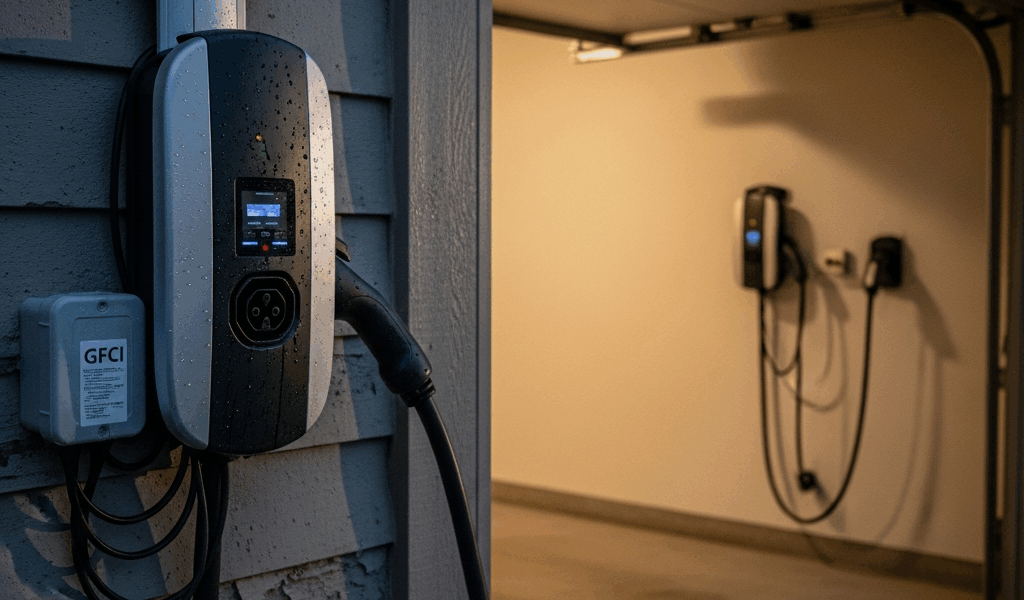
Outdoor 240V circuits live in a different world entirely. Building codes demand GFCI protection. Rain and humidity attack connections on a weekly basis. Wire runs stretch fifty, seventy, sometimes a hundred feet from the main panel out to a detached garage or backyard post. That distance matters — a lot. The diagnostic logic is actually straightforward: if it charges inside, your hardware is fine. The fault lives in the outdoor circuit, the environment, or both.
Check the GFCI Outlet or Breaker First
Most outdoor EV charger failures trace back to one culprit: a tripped GFCI. That’s it. Full stop.
The National Electrical Code requires GFCI protection on all outdoor 240V receptacles and hardwired chargers. Not optional. Your electrician installed it for a reason. But outdoor GFCIs trip constantly in wet climates — especially during the rainy months when condensation decides to move in uninvited.
Finding your GFCI is the first move. Open the main electrical panel and look for a breaker labeled “EV Charger” or “Outdoor Receptacle.” Modern panels mount the GFCI breaker right alongside the others. Some older installs use an in-line GFCI device mounted inside the outlet box itself — a gray or white rectangular unit with Test and Reset buttons stamped on the front.
Flip the breaker all the way off, then back on. Press Reset if you have an in-line unit. Plug in the charger immediately and attempt a charge. If it trips within seconds, head to the moisture section below. If it holds and the charger runs, you caught a nuisance trip — those happen after heavy rain when condensation settles inside the outlet box. Not a permanent problem on its own. But recurring trips mean moisture is getting in repeatedly, and that’s worth addressing before it becomes something worse.
Inspect the Outlet Box and Conduit for Moisture
Frustrated by three consecutive GFCI resets after a rainy stretch, I once pulled the cover off my own outdoor outlet box and found water droplets hanging inside like something had been weeping in there. Not ideal.
Turn off the breaker at the main panel before touching anything. Then carefully remove the outlet box cover. Look for these specific red flags:
- Water pooled at the bottom of the box
- Condensation beading on the inside of the cover
- Discolored or corroded wire terminals
- Rust streaks on the metal box itself
- Visible mud, leaves, or pest debris near the conduit entry point
Moisture inside outdoor boxes is incredibly common in wet climates — and incredibly fixable if you catch it early, before corrosion spreads to the terminals. Don’t make my mistake and ignore the early warning signs for weeks.
The cause usually comes down to improper conduit sealing. Conduit — the metal or PVC tube protecting your wiring — enters the box through a knockout hole. If that hole isn’t sealed with weatherproof conduit seal, or if the conduit sags and collects standing water, moisture travels straight to your terminals. Physics and gravity working against you simultaneously.
Here’s what actually works: dry out the box with compressed air or a hair dryer on low heat. Let it sit open — breaker still off — for a full day if the weather cooperates. Then seal every conduit entry point with weatherproof caulk rated for outdoor electrical use. Brands like Carlon or Hubbell make conduit seals designed exactly for this application. A tube runs somewhere between twelve and eighteen dollars and permanently closes the gap where conduit meets box.
If you see burn marks, melted plastic, or heavy corrosion on the terminals, stop immediately. Call an electrician. Corroded contacts generate heat, and heat causes fires. That’s not a DIY situation.
Test for Voltage Drop on Long Outdoor Runs
Probably should have opened with this section, honestly. Voltage drop explains a surprising number of outdoor charger failures that seem to come out of nowhere.
But what is voltage drop? In essence, it’s the loss of electrical force that happens as current travels through a long wire run. But it’s much more than that — because even a modest drop can push your circuit below the threshold your charger needs to operate.
Long wire runs from your main panel to an outdoor charging location are the core issue. Fifty feet out to a detached garage. Eighty feet to a driveway post. Electricity loses force over distance. Thinner wire makes it worse. An undersized wire on a long run combined with cold weather can drag a 240V circuit down to 215V or lower — which triggers the charger’s internal fault protection and shuts everything down.
Check this yourself with a multimeter. Set it to AC voltage. Have someone initiate a charging session while you hold the meter leads on the outlet terminals. A reading below 208V on a 240V circuit means voltage drop is actively happening. Drop below 200V and the charger won’t run at all.
The fix is upgrading wire gauge. A 50-foot run on a 40-amp circuit typically needs 8 AWG copper wire at minimum. A 100-foot run needs 6 AWG. Most professional installers get this right — but I’ve encountered plenty of DIY runs and older installs that used undersized wire to save thirty or forty dollars up front. Rewiring is a licensed electrician job, but knowing your actual voltage gives them a precise starting point.
I’m apparently more sensitive to cold-weather voltage drop than most people realize, and my January charging failures never made sense until I tested the circuit in February. Turns out wire resistance increases as temperature drops. Perfect voltage in July. Failing voltage in January. Same circuit, same wire. Cold weather just exposed what was marginal all along.
When to Call an Electrician and What to Tell Them
You’ve reset the GFCI. You’ve inspected the outlet box. You’ve tested the voltage. If the problem is still there, an electrician needs to take over — and the way you describe the problem will determine how quickly they solve it.
Here’s exactly what to say: “I need a voltage check at my outdoor 240V EV charging outlet and an inspection of the GFCI protection on that circuit. The charger works fine indoors but fails outside.”
That one sentence tells them you’ve already narrowed the problem down. You’re not wasting their time with a vague “my charger doesn’t work” call. You’ve done the diagnostic thinking for them. A good electrician will appreciate that — and your bill will probably reflect it.
Mention whether the GFCI is tripping repeatedly, whether you found moisture inside the box, or what your voltage reading was. Each of those details points them toward a specific fix and cuts down on labor time. That’s what makes this kind of preparation valuable to both of you.
If you’re in the Pacific Northwest and you’ve hit a wall, Northwest EV Charge handles exactly this type of outdoor circuit diagnostic on a daily basis. We’ve worked through hundreds of outdoor installations where the charger itself was completely blameless and the real problem lived in the circuit or the environment around it. Sometimes the fix is a twelve-dollar conduit seal. Sometimes it’s a full rewire. Either way, knowing what you’re actually dealing with before something fails completely is always worth the diagnostic call.



Stay in the loop
Get the latest northwestevcharge.com updates delivered to your inbox.