What Most Northwest Homeowners Actually Pay
EV charger installation costs have gotten complicated with all the conflicting numbers flying around. As someone who spent weeks talking to electricians across Washington, Oregon, and Idaho, I learned everything there is to know about what these installs actually cost in 2026. Today, I will share it all with you.
The real range for a straightforward residential setup in the Northwest sits between $1,200 and $3,500. That’s what you’ll see on actual invoices — not the national average that lumps Seattle electricians in with rural Nebraska labor rates.
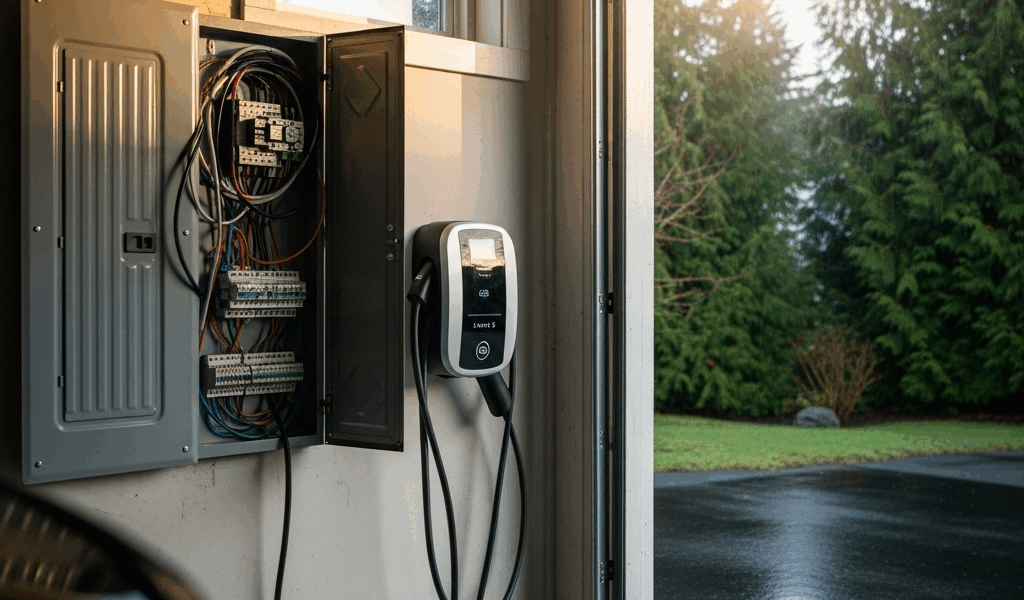
But what anchors that number? In essence, it’s a Level 2 charger (240V, 40-amp circuit) installed in an attached garage, an existing panel with open capacity, and standard permit fees. Clean job. Twenty feet of conduit, no obstacles, no surprises. But it’s much more than that simple scenario suggests.
After talking to a dozen electricians across the region, I realized that “straightforward” scenario is honestly the exception. Most homes need something adjusted. The panel’s full. The garage is detached. The run cuts through a crawlspace. Each variable pushes your invoice up $300 to $800 — sometimes more.
Seattle labor runs $85 to $110 per hour for licensed electricians. Portland sits at $75 to $95. Boise and surrounding areas come in at $65 to $85. That spread matters enormously when a panel upgrade eats 8 to 12 hours of work. A homeowner near Portland — attached garage, no panel upgrade, clean 30-foot run — should expect $1,400 to $1,800 installed. Same setup in Seattle? Add $400 to $600. That’s not a markup. That’s just the labor market.
The Four Things That Move Your Final Price
Distance from Electrical Panel to Charger Location
Every 10 feet of conduit run costs $100 to $200 in combined materials and labor. Most homes fall in the 20 to 40-foot range — but you’re counting the actual wire travel path, not a straight line. It goes through walls, up an exterior, maybe down to a basement panel and back up to a detached garage. Electricians charge per linear foot, and materials add up faster than most people expect.
Whether Your Panel Needs an Upgrade
This is the wildcard. Free 40-amp breaker slot plus enough total capacity? The install stays near base price. No surprises. But if the panel is maxed out or completely out of room, you’re looking at a service upgrade — a $1,500 to $3,000 add-on depending on your utility and local code. That’s the single biggest surprise cost in this whole process, so we’ll dig into it separately below.
Permit and Inspection Fees by State
Washington charges $150 to $300 per jurisdiction for electrical permits. Oregon runs $100 to $250. Idaho typically lands at $75 to $175. Non-negotiable fees, every one of them — and they vary city to city. Seattle permits cost more than Tacoma. Portland costs more than Salem. Check your local city or county website before getting a quote. This number doesn’t move once you know it, so lock it in early.
Charger Hardware Choice
A solid Level 2 charger — the JuiceBox 40 or Wallbox Pulsar Plus, for example — runs $400 to $800 at retail. Luxury units compatible with Tesla’s ecosystem push $1,000 to $1,500. That hardware cost gets bundled into the install. Labor to mount and wire it stays roughly the same either way. Don’t overspend here. I’m apparently someone who obsesses over specs, and a mid-range Wallbox works perfectly for me while premium units never justified their price. Don’t make my mistake.
Do You Need a Panel Upgrade and What Does It Cost
Probably should have opened with this section, honestly. A panel upgrade is the most common reason a $1,200 install becomes a $3,000 install.
Here’s the decision point: Level 2 chargers need a dedicated 40-amp circuit. That means a 40-amp breaker with room in your panel. If your panel is full — or simply doesn’t have 40 amps of headroom left — the utility and local code require a service upgrade. You can’t shuffle things around to make space. That violates code.
An electrician will assess your panel during the initial walkthrough. They’re checking two things: available breaker slots and remaining service capacity. Typical home panels run 100 or 200 amps total. A 40-amp charger circuit has to fit within that budget. Running central AC, electric heat, a large water heater, and modern appliances already? There’s often nothing left.
A 100-amp to 200-amp service upgrade in the Northwest costs $2,000 to $3,500 in labor alone — plus materials. That’s the big one. Stepping up from 150 to 200 amps runs $1,200 to $2,000. A panel replacement at the same amperage but with more breaker slots is cheaper — $800 to $1,500 — because you’re not touching the main service line coming from the street.
Some regional utilities offer cost-sharing programs worth knowing about. Puget Sound Energy has rebates and sometimes co-pays specifically for EV-related service upgrades. Pacific Power and Idaho Power offer similar incentives — though these programs shift year to year. Get the electrician to confirm whether an upgrade is necessary, then ask your utility about cost-share options before signing off on any final quote.
How to Lower Your Install Cost Without Cutting Corners
Get three quotes. Not two. Three. The spread between electricians in the same city can hit $500 to $800 — just from different hourly rates and contingency pricing. One electrician charges $95 per hour, another charges $75. On a 10-hour job, that’s $200 right there. Stack a few of those differences and the gap grows fast.
Stack rebates carefully. The federal 30C tax credit covers up to 30% of charger costs — capped at $1,050 in 2026 — but only when the charger meets federal standards and a licensed electrician installs it in a residential setting. That’s not automatic. Your equipment and install both have to qualify. Ask the electrician directly, and get documentation ready for tax time.
Puget Sound Energy in Washington offers $500 to $1,000 rebates on residential Level 2 installs, scaled by income. Pacific Power in Oregon runs comparable programs. Idaho Power has direct incentives as well. These don’t always stack cleanly with the federal credit — read the fine print carefully. You might qualify for one, both, or neither depending on your situation.
Permits are non-negotiable. Full stop. Do not hire an electrician willing to skip them. A failed inspection means tearing out completed work and starting over — $800 to $1,500 in extra costs versus the $150 to $300 the permit would have cost upfront. Most electricians handle permit coordination as standard practice. Confirm this before you book anyone.
While you won’t need to redesign your garage, you will need to think about charger positioning. If your panel is 40 feet away but a different wall puts you at 20 feet, that’s a $400 to $600 conversation worth having. Obviously you can’t move the garage — but sometimes the charger location has more flexibility than you initially assumed.
What to Ask Before You Book an Electrician
So, without further ado, let’s dive into the questions worth asking before you hand anyone a deposit. These save real money and confusion later.
- How many EV charger installs have you completed in the last two years? You want someone with direct, recent experience — not a general electrician treating this like any other rough-in job. Specificity here matters more than you’d think.
- Will you handle permit paperwork and inspections, or do I coordinate with the city? Clarify ownership of this step early. Most electricians include it. Some hand you a form and wish you luck. The first type is worth paying for.
- What’s your timeline from quote to completion? Standard installs run 1 to 3 days. Longer usually signals a backlog. Shorter might mean they’re rushing through it.
- What’s your labor warranty, and does it cover the charger hardware? Labor warranties typically run 1 to 2 years. The charger itself usually carries a 3 to 5-year manufacturer warranty. Get both numbers in writing.
- Does our utility offer rebate programs, and will you help with the paperwork? Some electricians have filed these forms a hundred times and know exactly what each utility needs. That’s what makes a seasoned EV installer endearing to us homeowners trying to navigate rebate programs alone. Others hand you a packet and say “figure it out.” The difference matters.
- Is the 40-amp circuit hardwired, or does it include a plug-in outlet? This affects future flexibility if you ever swap out the charger. Hardwired is standard — but worth confirming upfront either way.
Three quotes, a real panel assessment, and a clear picture of your local utility rebates will give you an actual number. Not a national average. Not an optimistic estimate. A price anchored to your specific home, your regional labor rates, and your state’s real cost structure heading into 2026.


Stay in the loop
Get the latest northwestevcharge.com updates delivered to your inbox.