Why Your EV Charger Keeps Stopping Before the Battery Is Full
EV charging has gotten complicated with all the conflicting advice flying around. You walk out to the garage expecting 95% and find your Tesla or Chevy Bolt sitting at 60% — charger completely silent, zero error lights, no explanation anywhere. Maddening doesn’t cover it.
But before you assume the hardware is fried, take sixty seconds to pull up your car’s app. Most EV owners don’t realize they’ve accidentally set a charge limit. A stray tap in vehicle settings, some auto-sync with a scheduling integration, whatever — and suddenly the car caps itself at 80% to “protect battery health.” I did exactly this my first winter with an EV. Spent two hours crawling around the garage before I noticed the little 80% slider sitting there in my vehicle settings, completely innocent-looking. Don’t make my mistake.
If your limit is genuinely set to 100% and the charger is still cutting out mid-session? That’s a hardware or electrical problem. That’s what this guide covers — the actual causes ranked by how often they show up, with fixes you can try today. So, without further ado, let’s dive in.
Thermal Shutoff Is Usually the Culprit
Level 2 home chargers have thermal protection circuits built in. Internal temp climbs too high, the unit cuts power automatically. Then it cools off and resumes — usually 30 to 60 minutes later. Repeat all night if conditions are bad enough.
This happens far more often than people expect. Especially in garages where ventilation is poor and the charger is wedged into a corner somewhere.
The pattern is pretty unmistakable. Charger works fine for a stretch, then stops. No error lights. You wait an hour, it charges again for another 30 or 40 minutes, then stops again. That cycle — that’s thermal shutoff. Not a failing unit. Not a wiring fault. Heat.
Check these things immediately:
- Clearance around the unit. Most EVSE manufacturers specify at least 6 inches of air space on all sides. Mounted in a corner? Tucked behind a workbench? It’s starving for airflow. Move it if you can — or at minimum clear the front and sides so heat has somewhere to go.
- Direct sunlight hitting the faceplate. Summer sun on an exterior-facing wall can raise internal temps 15–20 degrees Fahrenheit, even in cooler climates. A small weather hood helps — not a full enclosure box, you need venting — or just relocate the unit to a shadier wall.
- What the charger is mounted on. Dark metal panels, black painted brick, surfaces that bake in afternoon light — they radiate heat straight into the charger back. Light-colored surfaces or plain wooden studs are better. If your charger is bolted directly to a dark metal panel, that’s probably your problem right there.
- Garage temperature during sessions. Charging a 40-kWh battery in a 55°F garage while the charger case is already sitting at 110°F from afternoon heat buildup — thermal protection will trigger. Understanding the timing helps you rule other things out, even when there’s not much you can do about ambient temps.
Thermal shutoff is annoying. It isn’t dangerous. If clearing airflow and repositioning the unit doesn’t solve it, the charger may simply be undersized for that location. Call the installer or manufacturer — that’s a design issue, not something you can wire-fix yourself.
GFCI Trips and Loose Connections Come Next
But what is a GFCI trip, exactly? In essence, it’s a safety circuit cutting power the instant it detects even a tiny current leak. But it’s much more than that — because a weak connection, corroded outlet, or worn charge cable will trigger nuisance trips constantly, and they feel completely random from the outside.
Frustrated by repeated mid-charge stops one evening, I spent an afternoon going through my outlet with a flashlight — and found burn marks on the contact pins inside the wall box. That one detail told an electrician everything: moisture had worked into the outlet and was causing arcing at low current levels. GFCI was doing exactly what it was supposed to do. The outlet was the problem.
Walk through these checks:
- Inspect the charge cable visually. Nicks, kinks, crushed sections near the plug or handle — any of that, and the charger is done. Replace it. Damaged insulation will absolutely trigger GFCI shutoff, every time.
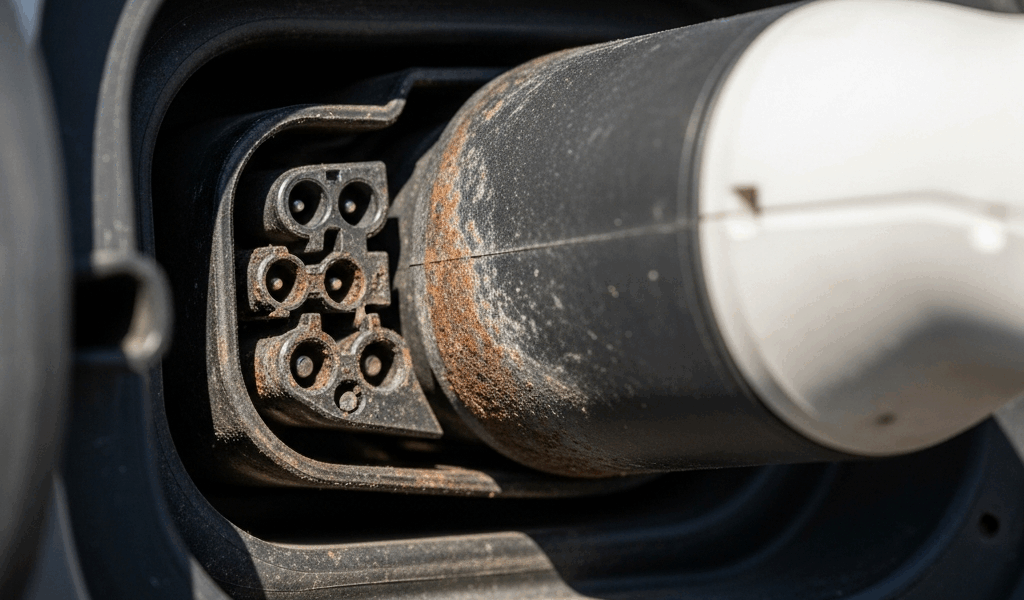
- Look inside the outlet itself. Discoloration, blackening, a faint burning smell, pitting on the metal contacts inside — stop using that outlet immediately. This is licensed electrician territory. Do not attempt a DIY fix here.
- Reset the dedicated breaker. Off for 5 seconds, back on. If charging resumes normally, great — nuisance trip, cleared. If it trips again within the same session, you have an ongoing ground fault that needs professional diagnosis.
- Feel the breaker switch after a charging session. It should be cool. Warm or hot means too much current through a connection that can’t handle it. That’s a fire risk. Call an electrician — not tomorrow, soon.
Probably should have opened with this section, honestly. Repeated GFCI trips mean wiring work, not more troubleshooting on your end. A licensed electrician can diagnose a failing outlet, loose lug, or undersized wire in under an hour. Figure $150–$400 depending on what they find. Worth every dollar compared to a charger replacement — or worse.
Car and Charger Communication Errors That Look Like a Fault
Your charger and the car’s onboard charger module run a constant handshake — a pilot signal that keeps power flowing. If that signal drops or gets corrupted, the charger stops. Even if nothing is overheating or arcing. Everything looks fine. Power just stopped.
Symptoms: charger goes silent mid-session, no red error light on the unit, car app shows no fault. That’s the communication dropout signature. That’s what makes it endearing to us EV owners — it’s the most confusing failure mode of the bunch.
Try these fixes in order:
- Unplug the J1772 connector and re-seat it firmly. Push until you hear the click and feel solid resistance. Loose connectors cause pilot signal dropout — it’s one of the more common causes people overlook. Hold it seated for a few seconds, press the release, try again.
- Plug into a different outlet if your charger runs on a split circuit. A secondary circuit sharing load with other garage equipment can cause voltage sag that interrupts the handshake. Swapping outlets rules it out fast.
- Check for a pending vehicle software update. Open your car’s settings or the manufacturer app — look for any waiting OTA updates. Outdated onboard charger firmware causes intermittent cutoff. Install the update and try again.
- Verify J1772 compatibility if your charger is 5+ years old. Older EVSE units occasionally struggle with faster communication protocols in 2023–2024 vehicles. Rare, but it happens. If you’re pairing an older charger — say a 2018-era ChargePoint Home with a brand-new EV — mention this to a technician before assuming the charger is dead.
If re-seating the connector fixes it, inspect the connector latch for wear. A loose connection will come back.
When to Call an Electrician — and What to Actually Tell Them
While you won’t need a full panel replacement for most of these issues, you will need a licensed electrician if any of the following are true. First, you should call one — at least if you’re seeing more than one of these:
- The charger stops across multiple sessions in a row, which rules out simple thermal cycling.
- The dedicated breaker trips or runs warm after charging.
- There’s discoloration or a burning smell at the outlet.
- The charger only stops when other high-load appliances are running simultaneously — dryer, oven, EV charger all at once. That points to panel overload or undersized branch wiring.
When you call, have this information ready: breaker size (usually 40–60 amps for Level 2), wire gauge if you know it (typically 6 or 8 AWG), whether the charger is on a dedicated circuit or shared, your charger model, and your vehicle model. A good EV electrician will recognize known compatibility issues immediately just from those details.
A dedicated 50-amp EV charger might be the best option, as Level 2 charging requires consistent, clean amperage draw. That is because even small wiring deficiencies compound over hundreds of charging cycles — what trips a breaker occasionally today becomes a persistent problem within months. Most residential panels handle one dedicated 50-amp circuit fine. Older homes or houses with high baseline electrical loads sometimes need a panel upgrade first. That’s a $2,000–$4,000 job — not what anyone wants to hear, but it’s the right fix if your service is the bottleneck.
I’m apparently more sensitive to charging interruptions than most people, and checking the app first works for me while ignoring small warning signs never does. Don’t ignore the problem. Most premature shutoffs trace back to thermal issues, a loose connection, or a communication hiccup — and a five-minute inspection catches most of them before they turn into something expensive.


Stay in the loop
Get the latest northwestevcharge.com updates delivered to your inbox.