Why Your EV Charger Keeps Tripping the Breaker
EV charger troubleshooting has gotten complicated with all the conflicting advice flying around. As someone who watched three neighbors in my Bellevue cul-de-sac fight this exact problem over the past two years — each with a completely different root cause — I learned everything there is to know about why these things keep tripping. Today, I will share it all with you.
The four usual suspects: an overloaded circuit juggling too many appliances at once, a worn or undersized breaker that buckles under the sustained 32-amp draw of a Level 2 charger, an internal fault inside the charger itself, or loose wiring connections that Pacific Northwest moisture has quietly corroded over time. Any one of these will ruin your 6 a.m. departure. So, without further ado, let’s dive in.
Step 1 — Rule Out the Charger Itself
Start here. Before you touch the panel or call anyone, figure out whether the problem lives inside the charger or somewhere else entirely.
The simplest test: unplug your EVSE from its outlet and plug it into a different 240-volt outlet — a dryer circuit, a hot-tub outlet, whatever you have available. No spare 240V outlet? Borrow a friend’s charger for an afternoon. A Level 2 charger rents for roughly $40 a day at most equipment rental shops if borrowing isn’t an option. Seriously, just rent one.
Charge for at least 20 minutes. If the breaker trips on the borrowed charger too, your EVSE isn’t the culprit. If it doesn’t trip, you’re dealing with an internal fault in your unit — probably a failed contactor or a short in the internal relay. Most EVSE units carry a three-year warranty. If yours is still covered, contact the manufacturer directly. Tesla, Wallbox, ChargePoint, Siemens — whoever built yours — and ask about a replacement unit. Don’t make my mistake of assuming it’s the wiring first.
Worth noting: a 32-amp Level 2 charger sits right at the edge of what a 40-amp breaker will tolerate. Breakers handle continuous loads at 80% of their rated amperage — that’s exactly 32 amps on a 40-amp breaker. Your charger pulling that full draw in a warm garage on a July afternoon? That alone can trigger nuisance trips even when nothing is technically broken.
Step 2 — Check Your Breaker and Panel
Probably should have opened with this section, honestly. But knowing what you’re testing first actually makes the panel inspection more useful, so here we are.
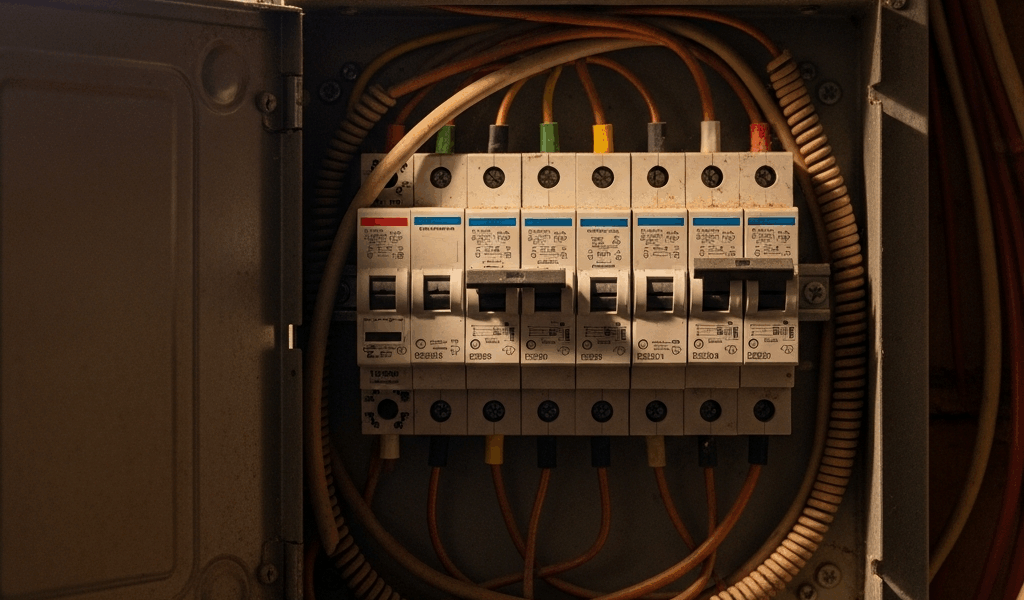
Open your breaker panel. The Pacific Northwest has a lot of older housing stock — if your house went up before 1990, check the breaker brand immediately. Federal Pacific, Stab-Lok, Zinsco? Those panels are known to fail under EV loads. Federal Pacific panels were installed in thousands of Northwest homes and carry documented fire risk at higher amperages. If you have one, stop troubleshooting and call a licensed electrician about a full replacement. That’s not a situation you work around.
Assuming your panel is more recent: find your 40-amp double-pole breaker — two handles joined together. They should feel firm and offer slight resistance when you flip them. Loose or spongy handles are a red flag.
Now the critical test. Turn the breaker all the way to OFF. Wait 10 seconds. Flip it back ON. Does it immediately snap back to OFF without the charger even plugged in? If yes, you have a short somewhere in the wiring or outlet box. Stop right there. Call an electrician. That diagnosis is not a DIY job.
If it holds after the reset, plug in and charge. Trips after several minutes of use typically point downstream — the outlet connection, the wiring run, or the charger itself. That’s what Step 3 covers.
Step 3 — Inspect the Wiring and Outlet Connection
Disconnected from power first. Turn off the breaker, unplug the charger, give it a full minute before you touch anything.
Check three locations: the outlet box where the charger plugs in, the wall entry point where the wire meets the outlet, and the breaker connection inside the panel.
The outlet should look clean and dry. Discoloration around the terminals — black marks, browning, visible corrosion — means a loose connection has been generating heat at the contact point. That’s what makes Pacific Northwest garages particularly rough on these installations. Morning cold, afternoon warmth, condensation, corrosion, resistance, heat. The whole chain plays out quietly inside your outlet box over months or years, and you never know until the breaker starts tripping.
Check the wire nuts holding the circuit wires together — the twist-on connectors. Can you wiggle them? Slightly loose wire nuts are incredibly common in homes over 20 years old. Discoloration or burn marks around them confirm they’ve been running hot.
Here’s the hard limit. Do not attempt to tighten wire nuts yourself if you’re not a licensed electrician. I’m apparently too comfortable around electrical panels and I’ve still seen this go wrong — a homeowner in Renton caused an actual fire trying to “fix” a loose neutral. A service call runs $150 to $250. A house fire costs everything. The math isn’t complicated.
What you can safely look at with the breaker off and the charger unplugged: visible corrosion, burn marks, cracked wire jacket, missing insulation. If you spot any of those, photograph them and text the images to a local electrician before scheduling. They’ll know from the photos whether it’s urgent or can wait for a standard appointment slot.
When to Call an Electrician and What to Tell Them
You’ve tested the charger on another circuit. You’ve confirmed the breaker doesn’t trip immediately on reset. You’ve scanned for visible corrosion and loose connections. Now you’re making the call — and how you describe the problem determines how fast you get a real answer.
Don’t just say “My EV charger won’t stop tripping.” Give them this instead:
- Breaker size — 40A, 50A, whatever it reads on the handle
- Wire gauge, if you can read it on the cable jacket (8 AWG is standard for 40A circuits)
- How long the charger runs before tripping — immediately, after 5 minutes, after an hour
- Whether the breaker trips on reset with no charger plugged in at all (that indicates a short)
- Year the house was built
- Breaker brand, if visible on the panel door
That detail eliminates redundant testing on their end. Faster diagnosis, more accurate quote — both of those matter when you’re paying by the hour.
One last thing: if an electrician quotes you a dedicated 50-amp circuit for a 32-amp charger, that’s the right answer — at least for the Pacific Northwest. A 50A breaker provides real headroom for a Level 2 charger and future-proofs the install if you ever upgrade to a faster unit. It’s become the standard for new construction across Washington and Oregon. Budget $800 to $1,500 depending on panel location and how far the wire has to run. Worth every dollar.
You’ve done the diagnostic work. You have the information. An electrician can now fix this properly instead of starting from scratch.


Stay in the loop
Get the latest northwestevcharge.com updates delivered to your inbox.