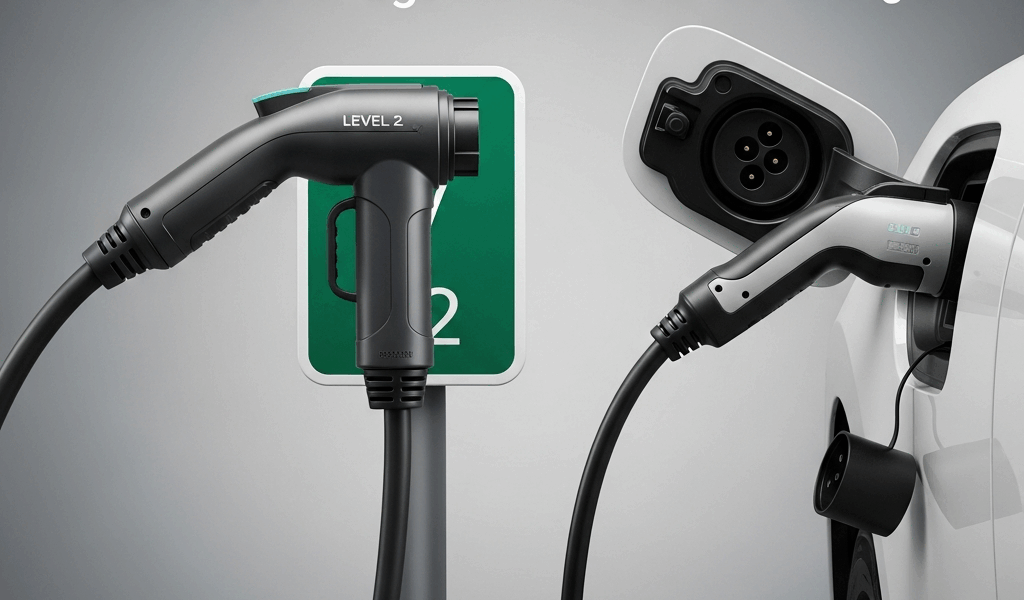
Level 2 vs Level 1 EV Charger — Do You Actually Need the Upgrade
The level 1 vs level 2 EV charger difference sounds like a simple spec comparison, but the real question is whether that difference actually matters for how you drive. And honestly, most of the content out there skips that question entirely. It jumps straight to “upgrade to Level 2” without ever asking how far you drive on a typical Tuesday. I bought a 2022 Chevy Bolt EUV and spent the first three months convinced I needed a Level 2 charger installed immediately. Then I started actually tracking my daily mileage. Turns out I was driving about 28 miles a day and had the car plugged in for nine hours every night. Level 1 was doing the job the whole time. I just didn’t know it yet.
This isn’t a guide telling you which charger to buy. It’s a framework for figuring out which one makes sense given your actual life — not some hypothetical road trip scenario that happens twice a year.
Level 1 vs Level 2 — Speed and Cost Side by Side
Let’s get the numbers out of the way first, because everything else flows from here.
Level 1 charging uses a standard 120-volt household outlet — the same one your microwave plugs into. No special installation. No electrician. You get the EVSE cord with your car, plug it into the wall, and you’re charging. The catch is speed. Level 1 delivers roughly 4 to 5 miles of range per hour of charging. If you plug in at 10 PM and unplug at 7 AM, that’s nine hours, which gives you somewhere between 36 and 45 miles of added range overnight.
Level 2 charging runs on 240 volts — same circuit type as your dryer or electric oven. You need either a NEMA 14-50 outlet or a hardwired charging unit installed by a licensed electrician. The speed jump is significant. A Level 2 charger delivers 25 to 30 miles of range per hour, sometimes more depending on the car’s onboard charger. A full charge on most EVs takes four to eight hours instead of overnight-plus.
Here’s a simple breakdown:
- Level 1 — 120V, standard outlet, 4–5 miles/hour, $0 installation cost (cord included with vehicle)
- Level 2 — 240V, dedicated circuit required, 25–30 miles/hour, $500–$2,000 installed depending on panel and distance
The hardware itself for Level 2 — something like a ChargePoint Home Flex or a JuiceBox 40 — runs $300 to $700 before installation. The installation is where costs vary wildly. If your panel is in the garage and has room for a new 50-amp breaker, you might pay $300 to $400 for labor. If the panel is on the opposite side of the house and needs a subpanel or an upgrade, you’re looking at $1,500 to $2,000 without blinking.
Speed and cost. That’s the whole comparison. Everything else is just context.
When Level 1 Is Actually Fine
Probably should have opened with this section, honestly. Because this is where most people’s decision actually gets made — and most articles bury it or skip it.
Level 1 works when the math works. And the math is simpler than it sounds.
Your Daily Commute Stays Under 40 Miles
If you’re driving 35 miles round trip Monday through Friday, Level 1 covers you. Nine hours of Level 1 charging gives you 36 to 45 miles. You plug in when you get home, you wake up with a full charge. Done. No electrician, no permit, no installation appointment.
I live in a suburb outside Columbus, Ohio. My commute to the office three days a week is 14 miles each way. On days I work from home, I barely move the car. Level 1 has never once left me short on range. Not once.
Your Car Sits Overnight for 10 or More Hours
This one matters more than people realize. Charging time isn’t just about speed — it’s about how many hours you have available. If you park at 9 PM and leave at 7 AM, that’s ten hours. At 4 miles per hour, you’re adding 40 miles of range. For a lot of drivers, that’s more than enough to top off whatever they used during the day.
The situation where Level 1 breaks down is when you have a short overnight window — say, you work nights, or you leave at 5 AM and you got home at midnight. Four or five hours of Level 1 is only 20 miles. That’s when the math stops working.
You Drive a Plug-In Hybrid
PHEV drivers are maybe the single group most oversold on Level 2. A Toyota RAV4 Prime has a 42-mile electric range and a battery that charges fully on Level 1 in about four and a half hours. A Ford Escape PHEV fully charges in about three hours on 120V. Level 2 for a PHEV is genuinely overkill for most people. You’d finish charging in 45 minutes instead of three hours, but you only need to charge once a day anyway.
It’s a Second Car That Doesn’t Drive Every Day
Plenty of households have a dedicated “short errand” EV that does grocery runs and school pickups. That car might drive 20 miles on a given day, then sit for 36 hours. Level 1 has no problem keeping up with that usage pattern. Spending $1,200 on a Level 2 install for a car that averages 15 miles a day is genuinely hard to justify.
When You Need Level 2
There are real situations where Level 1 just doesn’t cut it. Not hypothetical ones. Real, daily driving patterns where the math flips.
Your Daily Mileage Consistently Runs Over 50 Miles
Surprised by how many people I’ve talked to who are in this camp without realizing it. A 25-mile one-way commute is 50 miles a day before you’ve run a single errand. Add a school pickup, a detour to the pharmacy, and suddenly you’re at 65 or 70 miles. Level 1 adds 40 to 45 miles overnight. You start every morning already behind.
Running a consistent deficit on your battery is how you end up anxious at every traffic light, constantly calculating range. Level 2 solves this cleanly. Thirty miles per hour of charging means you’re fully recovered from almost any day of driving within three or four hours.
You’re Charging More Than One EV
Two EVs, one Level 1 cord, and a standard garage setup — this gets complicated fast. You can buy a second Level 1 EVSE for around $150 to $200 and use two outlets, but you’re still limited by the math for each car. A household with two EVs and two drivers with moderate commutes is a strong candidate for at least one Level 2 install, possibly a dual-outlet 240V setup.
You Use Your Car for Rideshare or Delivery Work
Frustrated by the number of rideshare drivers I’ve seen online giving Level 1 advice as if they’re weekend commuters. If you’re driving for Uber, Lyft, DoorDash, or any delivery platform, you are not a typical user. You might log 150 to 200 miles in a single shift. You need to charge fast, charge fully, and get back out there. Level 2 is not optional for this use case. It’s a business tool.
Cold Climate Reduces Your Effective Range
This one is underreported. Battery efficiency drops in cold weather — significantly. A 2021 Tesla Model 3 Long Range that gets 350 miles in July might deliver 240 to 260 miles in a Minnesota January. That range hit changes the charging math. If you were borderline fine on Level 1 in September, you might be genuinely short in February.
Cold weather also slows the charging rate on Level 1 slightly, which makes the problem worse in both directions. If you live somewhere that regularly dips below 20°F, factor that into the calculation before deciding Level 1 is enough.
Installation Cost and What to Expect
Talked to three different electricians before I made a decision about my own setup — not because I was indecisive, but because the quotes varied by almost $800. That variance is normal. Here’s what actually drives the cost.
The Electrician Visit
You need a licensed electrician for a 240V circuit install. This isn’t a DIY project unless you’re a licensed electrician yourself. The electrician will assess your panel, determine where to run conduit, and either install a NEMA 14-50 outlet or hardwire the charger directly. Labor typically runs $150 to $400 depending on your market and the complexity of the job.
Get at least two quotes. Prices vary more than they should.
Panel Capacity and Upgrades
Older homes — anything built before 1990 or so — sometimes have 100-amp panels. A dedicated 50-amp circuit for EV charging is a significant load to add to a panel that’s already running a HVAC system, a water heater, and a kitchen. Your electrician will check available capacity. If there’s room for a 50-amp breaker, great. If not, you’re looking at a panel upgrade, which starts around $1,500 and can run past $3,000 depending on the utility connection.
A 200-amp panel is typically sufficient for an EV circuit plus normal household loads. If your home already has 200-amp service, you’re probably fine.
Typical Total Cost Range
Here’s what most people actually pay, all-in:
- Simple install (panel has room, charger goes in garage close to panel) — $400 to $700
- Moderate install (longer conduit run, minor panel work) — $700 to $1,200
- Complex install (panel upgrade needed, long wire run, permit fees) — $1,500 to $2,500
The charger hardware itself adds $250 to $700 on top of that. A ChargePoint Home Flex (48 amp, adjustable) runs about $699. An Emporia Level 2 Smart Charger runs about $279 and does the job for most home setups. You do not need the most expensive unit on the market for typical home charging.
Rebates Are Real — Check Before You Pay Full Price
Many utilities offer rebates on Level 2 charger installation. Pacific Gas and Electric, Xcel Energy, and dozens of regional utilities have programs that cover $200 to $500 of installation cost. Some states have additional incentives. The federal 30C tax credit covers 30% of EV charger installation cost (up to $1,000) through 2032 for qualified homeowners.
Burned by not checking this early enough on my own research — I almost paid full price before a friend mentioned his utility had a $300 rebate sitting right on their website. Takes five minutes to look up your utility and search “EV charger rebate.” Do it before you schedule anything.
The Actual Decision Framework
Here’s how to think through it without getting lost in spec sheets.
Take your average daily mileage. Be honest — include errands, not just your commute. Divide that number by 4. That’s how many hours of Level 1 charging you need to recover what you used. If that number is less than the hours your car sits overnight, Level 1 works for you. If it’s more, you need Level 2.
Example: 60 miles driven ÷ 4 = 15 hours of Level 1 needed. Car sits for 9 hours. Gap of 6 hours. Level 2 is the right call.
Example: 32 miles driven ÷ 4 = 8 hours of Level 1 needed. Car sits for 10 hours. Level 1 covers it with time to spare.
Simple. Honest. Based on how you actually live.
The EV industry has a financial interest in selling you charger hardware and installation services. That doesn’t make Level 2 wrong — for the right use case, it’s genuinely the better tool. But a lot of people reading this have short commutes, long overnight windows, and a standard outlet in their garage already. For them, Level 1 isn’t a compromise. It’s the correct answer.



Stay in the loop
Get the latest northwestevcharge.com updates delivered to your inbox.