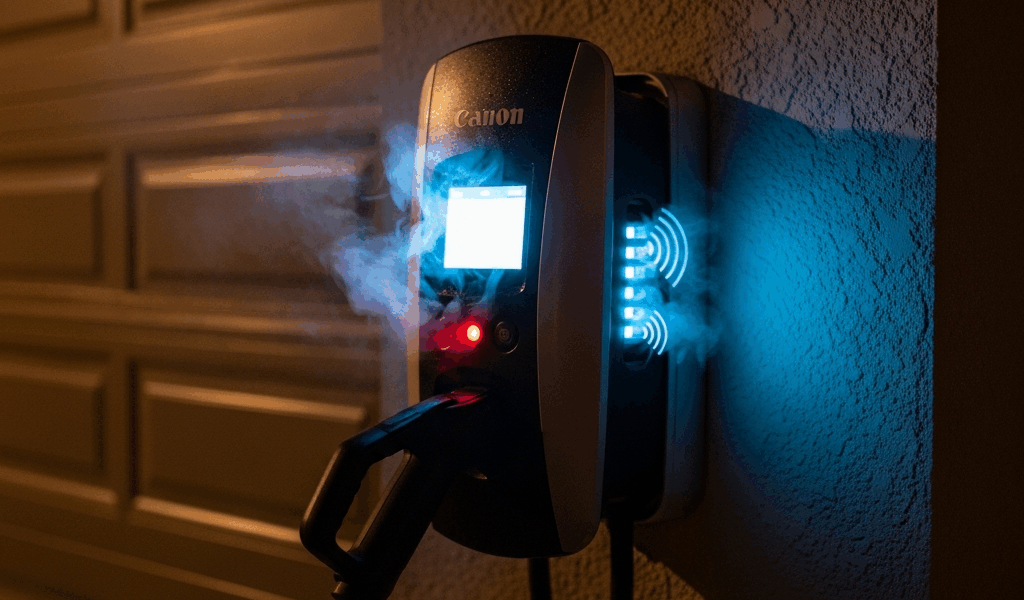
Why Your EV Charger Is Making Noise
EV charger noise has gotten complicated with all the conflicting advice flying around. Some people swear it’s always dangerous. Others say ignore it completely. Neither is right — and at 2 a.m. standing in your garage wondering if your $800 charger is about to catch fire, you need actual answers, not a forum argument.
As someone who spent three winters troubleshooting a rattling ChargePoint unit in an unheated Portland garage, I learned everything there is to know about why these things make noise. Today, I will share it all with you.
Here’s the short version first: some noise is normal. Your Level 2 charger has a transformer inside it. Transformers hum. The relay clicks when a session starts and again when it ends. That’s just physics. But not all charger noise is created equal — a soft buzz is nothing like a loud one, and a single startup click is nothing like rapid clicking at midnight.
Before anything else, just stand there and listen. Is the sound coming from the charger unit on the wall? The outlet itself? The breaker panel inside the house? Does it buzz, click, hum, or whine? That answer alone narrows this down significantly.
Buzzing Sound From the Charger Unit Itself
A buzzing sound from the charger unit usually comes down to three things: the internal transformer vibrating against its housing, a loose mounting bracket rattling the whole unit against the wall, or an actual electrical fault inside the circuitry. Start with the easiest one.
Walk out and check the mounting screws. Most Level 2 chargers bolt to a bracket with four screws — and in an unheated garage, temperature cycling loosens them faster than you’d think. Grab a socket wrench and snug them down. Not gorilla-tight. Just firm. A loose bracket turns every small internal vibration into a buzzing you can hear from inside the house.
If the mount is tight and the buzz sticks around, go look at your breaker panel. Don’t touch anything inside — just look. Check whether the wires feeding your charger circuit are seated properly at the breaker. Electricians occasionally leave connections finger-tight, and vibration does the rest over several months. I learned this one the hard way. Ignored a low buzz for about two weeks, finally checked, and found the connection warm to the touch. Don’t make my mistake. Tighten loose wire connections at the breaker with a flathead. If that makes you uncomfortable, an electrician can handle this in roughly 15 minutes.
Also worth doing: grab a three-light outlet tester — about $8 at Home Depot — and plug it into the outlet your charger uses. An open ground or reversed ground showing up on that tester is a legitimate problem. It creates electrical buzz and is a real safety issue. Call an electrician.
Stop charging immediately and flip the breaker if the buzz is loud, if you smell anything burning, or if you’re losing power mid-session. That’s not a “watch it for a few more days” situation.
Clicking Noise During or After Charging
Clicking at the very start or end of a session is normal. Your charger’s internal relay switches on and off — you hear it. Fine.
Abnormal clicking sounds different. It’s rapid. It happens mid-session. It repeats every few seconds for several minutes straight. That’s something cycling on and off when it shouldn’t be.
But what is a contactor relay? In essence, it’s the internal switch that controls power flow through your charger. But it’s much more than that — it’s also one of the first components to fail, especially in cold-weather conditions. Three things cause abnormal clicking: a faulty relay starting to stick or chatter, the charger’s thermal cutoff triggering because of an internal heat issue, or a communication error between the car and charger causing repeated reconnection attempts.
Frustrated by poor sleep and a charger that kept waking me up, I once sat in my driveway for a full hour logging exactly when my Clipper Creek unit clicked. Overkill, probably — but the timing actually mattered. Write down whether the clicking happens only in the first minute, throughout the whole session, or specifically on cold nights. If you have a WiFi-connected charger with an app, log in and pull the session history. Most modern units log error codes. Screenshot whatever you find before calling anyone.
Try a hard reset first. Breaker off for 30 seconds, then back on. Let it reboot. Try a fresh session. Communication glitches clear up on their own more often than you’d expect.
Cold weather matters here too. Some chargers won’t operate reliably below 40°F without a cord heater — and in the Pacific Northwest, 40°F is basically summer. Chattering relays in cold temps aren’t dangerous, just annoying. The manufacturer can tell you whether your specific model needs a cold-weather upgrade.
Clicking every night, getting worse? Call the manufacturer. Contactor relays do fail. That’s typically a warranty repair.
Humming or Whining From the Wall or Outlet
This one trips people up. The sound isn’t coming from the charger. It’s coming from the wall, the outlet, or the panel. That’s what makes this problem endearing to us EV owners — we assume it’s the charger’s fault, but the charger is just exposing something that was already wrong.
Undersized wire generates heat and a low hum under load. A loose neutral vibrates. A breaker pulling high current while seated poorly in the panel buzzes. Your charger didn’t cause any of this — it’s just the load that finally made the problem audible.
How to confirm: the sound shows up at the wall outlet while the charger is actively running. It stops when you unplug. You might also hear it from the breaker panel during a session. If that description fits, this isn’t a charger issue at all.
Call a licensed electrician. Show them exactly where the sound is coming from. Have them check the ground and neutral connections at the outlet. If your charger is running on a 40-amp circuit fed with 6-gauge wire instead of 4-gauge — that’s undersized for the load, and it needs to be corrected. Probably should have opened with this section, honestly, because wall-and-outlet noise is the one people most often misdiagnose as a charger problem.
Do not open the breaker panel yourself or go digging around in the wall. That’s how fires and electrocutions happen.
When to Stop Using the Charger and Call for Help
So, without further ado, let’s dive into the part that actually matters most: knowing when to stop entirely.
Stop using the charger immediately if:
- You smell burning plastic, rubber, or anything that resembles electrical insulation
- You see sparks or arcing at the connector or outlet
- The breaker trips while the charger is running
- The noise is getting louder or changing character over days or weeks
- The charger is hot to the touch or the outlet feels warm
When any of those happen, flip the breaker serving the charger — don’t just unplug it. Turn the breaker off. That removes power completely from the circuit.
Then figure out who to call. I’m apparently a “call the manufacturer first” person, and that approach works for me while going straight to an electrician never seems to get the right answers about warranty coverage. If the noise comes from the charger unit itself and you’ve already tightened the mounting and checked the wiring, call the manufacturer’s support line with your model number ready. They’ll walk you through a fix or start a warranty claim. If the noise comes from the wall or the panel, skip that step entirely — call an electrician directly.
One last thing worth saying plainly: ignoring electrical noise for months degrades components faster and can void warranty coverage. Most Level 2 charger warranties run five years. That’s a significant protection to throw away over a phone call you kept putting off.


Stay in the loop
Get the latest northwestevcharge.com updates delivered to your inbox.